The Banking View | Building market infrastructure for an always-on world

Oana Ifrim
20 Oct 2026 / 7 Min Read
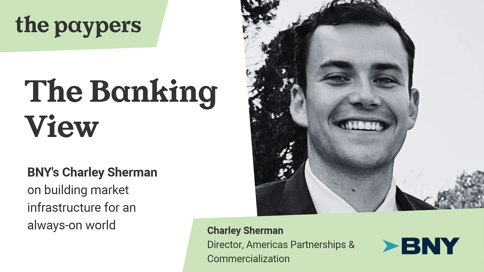
Speaking with The Paypers at Sibos 2026, BNY's Charley Sherman explains why the bank sees digital assets as the future of market infrastructure, tokenization, and client demand are shaping adoption.
Charley, can you please introduce yourself and explain how your role intersects with digital assets?
I'm Charley Sherman, and I lead partnerships and commercialisation for the Americas for our Market Transformation and Innovation hub. I work across BNY to structure strategic partnerships with the firm's partners and clients around our digital asset products and services, and to assist in bringing those products to market.
How would you describe the evolution of the US digital asset market, and what has changed most significantly in your clients’ demands?
We often describe it this way: regulatory enablement drives ecosystem adoption, which in turn drives client demand. In the US especially, the GENIUS Act is now translating into real adoption, flows, and client demand.
A few years ago, clients were either running targeted tokenization pilots and proofs of concept or exploring how to launch and service crypto as a new asset class. Today, they see it as the future of financial market infrastructure. They want to embed the technology into institutional workflows and put real volumes and real assets on chain.
As a result, we're seeing demand across asset classes, not only from crypto-native firms but increasingly from traditional financial institutions: wealth managers, asset managers, banks, and broker dealers, corporates, insurers, and others. All client segments are working out how to build a future on-chain operating model for an always-on environment.
It's an exciting time for BNY because we serve these clients as an end-to-end market infrastructure provider.
What role do established financial institutions have to play in this market, and how do you see them supporting it through security, custody, safekeeping, and the integration of digital assets?
Trust and security will be critical in this space. That means strong risk management, controls, and cybersecurity, but also a long track record of understanding clients' business models: how they work in practice, the teams running them, and what those teams need.
That's where BNY is well positioned. For more than 240 years, we've supported institutional clients, and our role as a custodian has helped enable a broad range of use cases. Because digital assets also require custody, we have extended that same expertise into the digital ecosystem.
We've focused on the core capabilities needed to safekeep both traditional and digital assets as more come on chain. We're also working with clients to mobilise those assets for collateral, settlement, and payments, enabled by our digital market infrastructure. This includes connectivity to our private blockchain and to third-party blockchains.
These capabilities are essential,but clients are looking for more than technology. They want a trusted provider that can help them enter this market securely and confidently as they develop new business models and services.
Do you have a client example you can share?
A good example is our work with a leading asset manager seeking to attract new assets by offering differentiated fund structures that respond to end-investor demand.
Crypto ETFs and ETPs are one way the industry has done this, giving investors exposure to digital assets through familiar, regulated structures. Behind the scenes, though, the service model is more complex.
Managers still need fund accounting and administration, as well as an additional capability: digital asset custody. The custodian safekeeps the crypto backing the ETF in a compliant, resilient way, protecting against cyberattacks and asset loss.
For this client, we combined our fund servicing and digital asset custody capabilities into an integrated solution, extending our existing relationship into digital services while providing the resilience and scale the client expects from a long-term trusted provider. This also helped the client offer a new digital investment product through an established servicing model.
Tokenization is moving from experimental to practical use. Where are you seeing the strongest institutional use case?
Tokenization and stablecoins go hand in hand because every transaction has both an asset leg and a cash leg. Bringing the cash leg on-chain through US dollar-backed stablecoins has, in turn, created demand to tokenise the assets that support their reserves, including dollars, Treasuries, and money market funds. For market participants operating 24/7, having both sides of a transaction available on-chain enables more efficient settlement. That is why many of the earliest tokenization use cases have focused on these asset classes.
Tokenized money market funds offer two key advantages. First, they give investment managers a new distribution channel to provide on-chain yield, which appeals to stablecoin issuers and the wider digital native investor community. Second, they make the funds more useful: they can be transferred and posted as collateral. More broadly, tokenized money market funds and other tokenized assets can be accessible around the clock, with programmable logic built in. We also see an opportunity for tokenization to support the evolution of Treasury markets toward an always-on model. Tokenized deposits are another promising use case, supporting payments, settlement and value transfer on-chain.
Looking ahead, I expect to see asset classes tokenized that have historically been less transparent or harder to access.
What do you think will be the next area of tokenization to pick up?
I expect a continued push toward tokenized funds, extending from money market funds to other fund structures across a broader range of assets. Exchanges are also looking to offer tokenized securities, enabling 24/7 trading and greater utility. This will be particularly valuable for certain asset classes that are difficult to access.
Private markets are another growth opportunity, with demand expanding across both private assets and fund structures. Beyond enhancing distribution and investor access, digital infrastructure has the potential to modernise how these assets are serviced, financed, transferred, and managed. For BNY, putting loans and funds on-chain can help transform manual, fragmented processes into more connected, interoperable, and efficient workflows across the private asset lifecycle.
Digital cash is emerging as an important area of development in its own right, closely related to stablecoins. What is changing in payments, settlement, and liquidity management?
Whenever assets come on-chain, whether they're being bought, sold, or used in a repo transaction, there needs to be a cash leg. Bringing cash on-chain is therefore just as important, allowing the broader financial market infrastructure to operate in this new way, with programmable logic built in.
We believe stablecoins, tokenized money market funds, and tokenized deposits will coexist, and we want our clients to be able to operate across these forms of digital cash, whichever they choose.
We launched tokenized deposits in 2025 and will continue to build on it. One use case is transferring funds between BNY clients outside traditional business hours, such as paying a counterparty 24/7. Another is moving cash margin over the weekend to the large clearinghouses and exchanges that now support 24/7 trading. These are essentially high-value transfers conducted within BNY, using tokenized deposits.
As for stablecoins, we began by partnering with issuers as a reserve custodian, cash and transactional bank, and investment manager. Initially, our role as a service provider was to help them become operationally sound. Now, those issuers are asking how BNY and other partners can help grow the utility and adoption of their stablecoins.
At the same time, institutional stablecoin users are emerging, and BNY clients want to explore additional uses for stablecoins. We've introduced stablecoin transfers on our Digital Asset Custody platform and, a couple of months ago, launched an integrated mint-and-burn model with issuers.
As the competitive landscape evolves, what are institutional clients looking for from digital asset providers, and how can established financial institutions and digital-native companies combine their respective capabilities to address those needs?
Clients rarely say, “I want to do something in digital assets.” They say, “I want to grow my platform or solve an operational or capital efficiency problem, and I believe blockchain and tokenization could help.”
Much of the value lies in enabling interoperability between clients' existing systems and new ones, whether self-built, from infrastructure providers or from digital-native and fintech partners.
Our Digital Asset Custody platform is a recent example. BNY was the first global systemically important bank in the US with a solution of this kind. For clients holding eligible assets such as Ethereum or Solana, staking can provide an opportunity to generate rewards on their assets. To address this need, we partnered with Galaxy, which provides the staking infrastructure while BNY safekeeps the assets.
BNY has brought a lot to market. Of everything you've mentioned, what is the single biggest commercial opportunity?
Can I say all of it? BNY's real goal is to serve as financial market infrastructure for the future, connecting our traditional and digital systems and relationships with these new innovations, across the asset lifecycle.
In the near term, we're already seeing momentum in custody, in fund tokenization and digital transfer agency, and in digital cash through stablecoins and tokenized deposits. Over time, this will evolve to make collateral, payments and settlement better, faster, and more efficient.
It's a broad answer, but each of these is a foundational pillar of a wider opportunity, and helps prepare us for a future we believe will be always-on.
We're at Sibos, so it seems fair to ask: three years from now, what will the big talking point be?
I hope digital assets will no longer be the buzz. Instead, I'd like the conversation to focus on the technology itself, with blockchain and tokenization simply as enablers and financial market infrastructure. We're already seeing a shift in that direction, as these topics increasingly become part of mainstream industry discussions.
Ultimately, we want it to be so fully integrated that we no longer think about it, with the technology simply working in the background. That's the value we're aiming for, for BNY, our partners, and our clients.
This interview is part of The Banking View, The Paypers' series featuring senior bank executives on the payments and regulatory challenges their institutions are working through. Read all Banking View interviews.
About Charley Sherman

Charley leads Americas Partnerships & Commercialization for BNY’s Market Transformation & Innovation Hub, driving commercial strategy across BNY’s digital asset products. Previously, he was part of BNY’s Growth Ventures group, focusing on data & analytics partnerships. Prior to joining BNY, Charley worked at McKinsey & Company, where he served fintechs, financial market infrastructure firms, and banks across a wide range of topics, including growth strategy, digital assets, and go-to-market.
About BNY

BNY is a global financial services company at the center of the world’s capital markets. For more than 240 years, it has helped clients operate efficiently and grow, serving over 90% of Fortune 100 companies and nearly all top 100 banks globally. As of June 30, 2026, BNY oversees USD 62.6 trillion in assets under custody and/or administration and USD 2.2 trillion in assets under management.
News on Crypto, Web3 and CBDC

The Paypers is a global hub for market insights, real-time news, expert interviews, and in-depth analyses and resources across payments, fintech, and the digital economy. We deliver reports, webinars, and commentary on key topics, including regulation, real-time payments, cross-border payments and ecommerce, digital identity, payment innovation and infrastructure, Open Banking, Embedded Finance, crypto, fraud and financial crime prevention, and more – all developed in collaboration with industry experts and leaders.
Current themes


No part of this site can be reproduced without explicit permission of The Paypers (v2.7).
Privacy Policy / Cookie Statement
Copyright