The Banking View | Why banks still matter: navigating innovation and trust in a changing financial landscape

Oana Ifrim
11 Feb 2026 / 10 Min Read
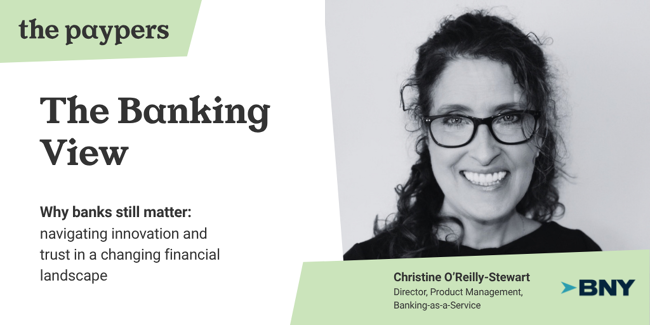
Christine O’Reilly-Stewart, BNY: Fintech innovation, regulatory change, and the rise of Banking-as-a-Service are redefining the relationship between banks and their challengers.
Who still needs banks? It’s a question that’s been asked with increasing frequency in recent years – though the answer is far from straightforward. The growth of fintechs offering digital-first, customer-centric services has led some to view traditional banks as slower to adapt to changing expectations.
Adding to this evolving landscape has been the shifting of regulations around new banking charters in the US, which has led to a rise in de novo banks – newly established institutions built from the ground up – and prompted fresh debate about the long-term role of traditional banks. While the current environment may appear more favorable for new entrants, history shows that regulatory tides can turn quickly. And when they do, it’s the institutions with experience in navigating risk and uncertainty that are best positioned to adapt.
That principle is reflected in the rising popularity of Banking-as-a-Service (BaaS) models, enabling fintechs and other third parties to offer financial products by leveraging traditional banks’ infrastructure. The BaaS market, valued at USD 21.27 billion in 2023, is projected to quadruple to USD 85.73 billion by 2032.
This surge in popularity is, in part, driven by the mutual benefits offered by BaaS. Customers gain access to innovative financial solutions; emerging players tap into robust infrastructures they would otherwise be unable to access; and incumbents have the opportunity to unlock new revenue streams by monetising their regulatory expertise, compliance frameworks, and trusted status.
This evolving BaaS model, however, is not without its challenges. In the US, particularly, the regulation landscape is in constant flux, and innovation using real-time payments, tokenized deposits, and blockchain integration will continue to reshape the industry. This ongoing evolution means that uncertainty persists around which party must assume each responsibility – from compliance and risk management to consumer protections. What’s more, future changes are likely as new technologies and business models emerge.
To ensure the BaaS market reaches its full potential, banks and fintechs must foster productive, transparent and accountability-driven relationships. But what does this look like in practice?
Establishing a productive BaaS partnership
Successful BaaS relationships are built on early alignment – well before contracts are signed. Prospective partners should share compatible values, business objectives and risk appetites to lay the groundwork for trust and collaboration. The structure of the relationship should also reflect the maturity of the fintech. Early-stage firms, for instance, may require support and oversight, while more experienced fintechs may benefit from greater operational freedom.
Critically, each party’s roles and responsibilities – particularly around compliance, risk, and oversight – must be clearly defined from the outset. This isn't just about meeting regulatory expectations; it’s about enabling sustainable innovation and ensuring the partnership can scale successfully.
Delegating effectively: The duties of banks vs. fintechs
So, how exactly should the respective responsibilities between BaaS partners be delegated?
One way to approach this is to see the bank’s role as being most effective when focused on delivering core strengths, such as custodial services, payments infrastructure, and compliance capabilities. The fintech, meanwhile, can bring additional value by innovating and delivering distinctive, user-centric financial experiences.
Such arrangements come with notable complexities in practice, not least those related to compliance – the burden of which largely falls on the BaaS provider. The reason is straightforward: banks are generally better equipped for this role, thanks to their capital adequacy, established risk frameworks, and deep experience operating under regulatory supervision. Expecting emerging fintechs to fully shoulder these responsibilities from the outset can be both costly and counterproductive – and potentially hinder innovation.
In addition to leading on compliance, BaaS providers must be equipped to support their partners’ growth. This involves investing in scalable infrastructure, establishing robust oversight processes, and maintaining strong internal controls. Keeping pace with payments innovation is also essential to meeting partners’ needs, which increasingly centre on seamless, modern experiences and the ability to innovate on top of payment rails and other banking products in a rapidly evolving ecosystem. Without these foundations in place, there’s a risk that the fintech could outpace their provider’s capabilities – and look elsewhere for support.
These challenges are particularly acute for business models involving consumer-facing services, which carry higher regulatory expectations, greater reputational risk, and increased scrutiny. For fintechs, a pragmatic approach may be to initially focus on business clients – enabling them to build compliance maturity in collaboration with their BaaS provider before expanding into more sensitive areas.
Collaboration is key
With the course of regulation always changing, BaaS partnerships must remain flexible. While every bank has its own interpretation of regulatory requirements, fintechs may be more willing to test boundaries. This dynamic can favor BaaS providers that are ready to engage constructively in an evolving marketplace. Regardless of how these dynamics unfold, collaboration between banks and non-banking partners remains instrumental to the success of BaaS ventures.
Even when the written rules are the same, banks may translate broad obligations, such as mitigating concentration risk or protecting customer data, into very different policies and controls. Jurisdictional nuances, business models, risk appetites and technological capabilities all influence how banking obligations are translated into policies and controls. Indeed, history has shown us why banks’ depth of experience is so vital. Traditional banks remain the cornerstone of financial safety and stability, and this safety net is essential as new technologies and business models continue to reshape the financial ecosystem.
The early days of the de novo banking movement illustrated what can happen when innovation outpaces regulatory understanding – ultimately raising concerns about market stability and compliance. With the rise of BaaS, the pendulum is gradually swinging back to a more balanced position. Both banks and fintechs increasingly recognise that collaboration is essential to building a resilient financial ecosystem.
At BNY, we manage this complexity through ongoing dialogue with regulators, embedding compliance with the design of our systems, and participating in industry forums to help shape best practices. This multi-layered approach ensures that we remain ahead of emerging expectations and stay adaptable. In a rapidly changing environment, the partners that do well are those that embrace complexity – balancing risk management, innovation, and operational capability, while building trust through collaboration and shared expertise.
This contribution is part of The Banking View, The Paypers' series featuring senior bank executives on the payments and regulatory challenges their institutions are working through. Read all Banking View contributions.
About Christine O’Reilly-Stewart

Director, Product Management, Banking-as-a-Service.
About BNY

BNY is a global financial services platform company at the heart of the world's capital markets. For more than 240 years, BNY has partnered alongside clients, using its expertise and platforms to help them operate more efficiently and accelerate growth. Today, BNY serves over 90% of Fortune 100 companies and nearly all the top 100 banks globally. BNY supports governments in funding local projects and works with over 90% of the top 100 pension plans to safeguard investments for millions of individuals. As of December 31, 2025, BNY oversees USD 59.3 trillion in assets under custody and/or administration and USD 2.2 trillion in assets under management.

The Paypers is a global hub for market insights, real-time news, expert interviews, and in-depth analyses and resources across payments, fintech, and the digital economy. We deliver reports, webinars, and commentary on key topics, including regulation, real-time payments, cross-border payments and ecommerce, digital identity, payment innovation and infrastructure, Open Banking, Embedded Finance, crypto, fraud and financial crime prevention, and more – all developed in collaboration with industry experts and leaders.
Current themes


No part of this site can be reproduced without explicit permission of The Paypers (v2.7).
Privacy Policy / Cookie Statement
Copyright