A2A payments: five different regional approaches to one technology

Vlad Macovei
16 Nov 2026 / 10 Min Read
Account-to-account (A2A) tech will likely keep gaining share, although unevenly across markets and use cases. At the same time, A2A payments are evolving along different paths, despite relying on similar real-time payment (RTP) infrastructure. The main differences come from policy models, use case adoption, economics, legacy payment method displacement, and approaches to trust and dispute resolution. As a result, the competitive question, once related to the fastest rail owner, is now: who can build the most sustainable operating model around it.
Account-to-account (A2A) payments are value transfer solutions that keep evolving. Built on now widely available RTP infrastructure, they are changing payment use cases in terms of who gets paid and who is liable when things go wrong. Over the last couple of years, A2A evolved from a primarily technology focus to one on operating rules and payment economics.
However, we are seeing fragmentation in development approaches. Despite resting on similar technological foundations, A2A is evolving very differently across geographies. As shown in Fig. 1, five dimensions explain much of that divergence.
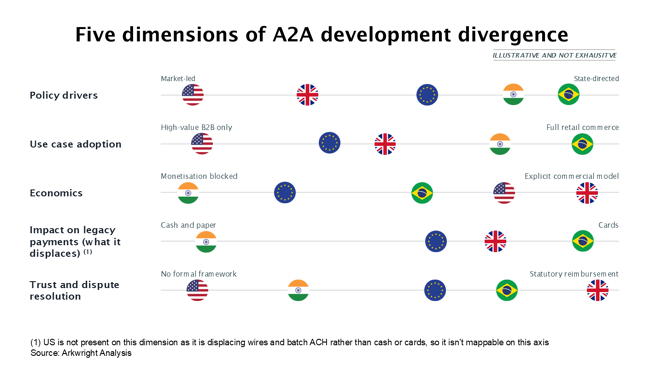
Policy drivers: who is pushing A2A and shaping much of what happens
The EU has legislated A2A payments capability. The Instant Payments Regulation (IPR) prompts Euro-area payment service providers (PSPs) to receive instant transfers from January 2025 and to send them from October 2025, at price parity with ordinary credit transfers, with Verification of Payee (VoP) included. Therefore, basic capability adoption is largely a compliance outcome, not a commercial one. Similarly, PSD3 and the Payment Services Regulation (PSR), agreed politically in November 2025, extend the same strategic goals into fraud liability, consumer protection, and API quality. However, their final application timetable depends on formal adoption and transition periods.
The UK has taken a different route for commercial A2A. Instead of mandating a universal commercial payment product, regulators pushed the industry to develop a sustainable scheme and commercial model. The UK Payments Initiative (UKPI) was the result, and its commercial variable recurring payments (cVRPs) scheme went live in June 2026. While slow to arrive, the underlying premise is that participants need a reason to invest in and maintain it.
Brazil and India are closer to a state- or institution-led product management model. Banco Central do Brasil, apart from regulating Pix, defines its features and publishes the product roadmap. The National Payments Corporation of India (NPCI) plays a similar role for its Unified Payments Interface (UPI) service. Both systems have benefited from unusually strong institutional coordination and policy support, while mandatory participation requirements have been particularly important in Brazil.
The US has no single coherent driver, and FedNow and The Clearing House's RTP network operate in parallel. The CFPB's Section 1033 rule, the legal basis for the data access on which payment initiation depends, has been halted by the courts and reopened for reconsideration, while stablecoins have had considerable policy attention following the GENIUS Act. American consumer A2A payments remain largely market-led and, consequently, have developed slower than in several other major markets.
In Europe, another driver overlaying all of this is sovereignty. Dependence on international card schemes, once primarily a competition-policy concern, is now a strategic consideration. This explains why the European Payments Initiative's (EPI) Wero has the political backing earlier bank-led initiatives often lacked.
A2A payments use cases: adoption is not consistent
A2A does not spread evenly across payment types, tending to move from easier use cases to harder ones.
Recurring and bill payments are a logical segment, as card-on-file has structural weaknesses here: expiry dates, involuntary churn, and limited consumer control over recurring mandates. The UKPI scheme started with utilities, government, charities, and financial services. Brazil's Pix Automático, launched in June 2025, targets much of the same segment from a different starting point.
High-value B2B payments are the other end of the spectrum, and an increasingly important source for US momentum. Both the RTP and FedNow raised their transaction limits to USD 10 million in 2025, enabling greater use in corporate treasury, payroll, property transactions, and other payments that previously relied more on wires or batch ACH.
Ecommerce checkout is a partially contested middle. Amazon and eBay both launched Pay by Bank in the UK in early 2026, importantly signalling demand that had not existed before. However, availability stopped being the only constraint. Consumer familiarity and trust are important aspects to consider, and UK research suggests Pay by Bank awareness lacks consistent growth.
Point-of-sale is the newest front A2A payments are trying to conquer. Pix por aproximação brought NFC-initiated A2A payments to Brazil in 2025, and Bizum has been preparing an in-store wallet in Spain. These are among the first serious attempts to challenge cards on their strongest territory.
Interface design is a less obvious determinant. Proxy addressing (paying to a phone number or handle rather than an account number) helped make Pix, UPI, Swish, Bizum, and BLIK feel native to consumers, and its absence is conspicuous in markets with slower A2A payments adoption. Conversely, the redirect journey that European Open Banking inherited from PSD2 remains an important source of checkout friction.
While A2A payments are positioned as a card competitor, challenges for A2A that continue in most markets include impulse purchases, credit-funded spending, rewards-driven behaviour, and cross-border payments. Therefore, the more realistic framing is which aspects of card usage are replaced first, and what remains in the card stack afterwards.
Economics: the biggest differentiator and a key driver of investment sustainability
A price parity mandate comes with monetisation challenges. This is seen with the IPR, which requires European banks and PSPs to build and operate instant payment capability while preventing them from charging more than for an equivalent ordinary transfer. Although the approach ensures payment method availability, it risks producing compliance-led differentiated investment, rather than commercial-led.
Zero Merchant Discount Rate (MDR) furthers this issue. UPI's volumes are the largest in the world and generate no direct merchant revenue through MDR, which is why India is now debating whether to apply selective charges to higher-value transactions or larger merchants, while leaving most everyday payments free. The alternative is continued cross-subsidy by banks, payment apps, or government support.
Scheme-led markets have a reversed approach: first establish a commercial model, then scale. UKPI exists, in part, because a decade of Open Banking-enabled payments demonstrated that a payment rail without a rulebook and a sustainable commercial model does not necessarily attract sufficient investment.
What remains unanswered is whether the fee stack on a ‘cheap’ A2A payment ultimately reaches that of card economics once disputes, guarantees, fraud tooling, consumer protection, and a scheme operator all need funding. If it does, the merchant savings case becomes less compelling.
Meanwhile, value is migrating from the transaction toward overlays: payment guarantees, credit, payment orchestration, and reconciliation data. In the US, some of that value has moved directly to the data layer: in 2025, JPMorgan decided to charge aggregators for account data access, arguing that most traffic was not tied directly to customer action. ‘Who pays for the infrastructure’ is the same argument (shaped differently), and its resolution will directly affect Pay by Bank economics in the world's largest card market.
Impact on legacy payment types: A2A and what it displaces depends on previous market preferences
Where cash and cheques dominated, A2A payments became the substitute at extraordinary speed. Pix and UPI are just as much about inclusion and digitisation as about disruption.
In a direct debit context, A2A may be better understood as an upgrade and not a complete replacement. Commercial VRPs offer consumer-set limits, duration, and cancellation, effectively bringing mandate-based payments into a more flexible digital environment.
Where cards dominate, displacement is partial. Cards still bundle payments with credit, rewards, fraud protection, and dispute resolution, making some use cases considerably harder for A2A payments than others.
Brazil remains particularly interesting because the market has experimented with Pix-based instalment and credit propositions that could, over time, compete with parcelamento (card-based instalment credit and one of the central features of Brazilian card economics). Banco Central do Brasil had explored standardising Pix Parcelado, although it stepped back from creating a formal standardised scheme in late 2025. Competitive pressure from credit-funded Pix propositions remains, nevertheless, relevant.
Wholesale payment rails are affected too. In the US, higher instant payment limits are allowing some volume to migrate from wires and batch ACH. However, this receives far less attention than the retail use case.
Incumbents have not stood still. Visa launched Visa A2A in the UK, adding card-style protections and dispute mechanisms on top of bank payment rails. Mastercard has also expanded its Open Banking and A2A infrastructure capabilities across Europe. Both networks increasingly position themselves as rail-agnostic service providers, not just card networks. This strategically challenges pure-play Open Banking providers, whose original assumption was that the networks were being disrupted. If Visa and Mastercard can provide scheme, trust, and dispute services on top of bank rails, the distinction between incumbent and disruptor is considerably less obvious.
Trust and dispute resolution: the hardest dimension due to diverging merchant and consumer interests
Cards have mature frameworks to allocate fraud and dispute losses, supported by scheme rules, issuer and acquirer liability, merchant obligations, and the broader card system economics. Historically, push payments lacked an equivalent standardised consumer-choice framework, particularly once a payment was authorised and settled. Now, every market is building its own version, and the choices differ significantly.
The UK has gone furthest on reimbursement, making authorised push payment (APP) scam reimbursement mandatory from October 2024, and splitting the cost between sending and receiving payment providers. The PSR's independent evaluation found that APP losses over Faster Payments fell by roughly a fifth in the first year following implementation, alongside a modest positive net economic benefit. This is important evidence of how liability allocation can change provider behaviour rather than redistribute losses.
The EU has combined fraud prevention with expanded liability. VoP checks the payee’s name against the IBAN before authorisation. It is being implemented through competing national and pan-European solutions instead of through a single utility, which makes interoperability something to watch. The PSR also extends liability outward in defined circumstances, including to large online platforms that fail to act when notified of fraudulent content.
Brazil built dispute handling directly into Pix through the Special Return Mechanism, subsequently refining it with self-service contestation and other enhancements. It does not leave recovery entirely to bilateral bank negotiation.
The commercial fraud aspect remains unresolved. Many merchants prefer A2A payments partly because dispute and chargeback costs can be lower, if any, compared to cards. However, for larger purchases in particular, consumers appreciate the protections that make card payments more expensive.
Amazon's UK launch is rather informative: instead of depending entirely on the payment service, it extended its marketplace guarantee to cover Pay by Bank purchases. Visa’s A2A approach is the opposite, adding recourse and protection to the underlying bank payment rail.
Who funds that recourse and at what price will help determine whether A2A payments remain a meaningfully cheaper alternative or evolve into something closer to card payment economics.
Conclusion
A2A payments are not developing within a single model. Although the underlying technology is increasingly common, each market shapes economics, governance, liability, and customer proposition very differently.
Market evolution and competition will not depend on who has the fastest rail. Those who can build a sustainable operating model around the rail, including incentives for participants, effective fraud and dispute mechanisms, and a customer experience strong enough to change behaviour, will impact A2A payments most. And while A2A payments will continue to take share from legacy payment methods, they will do so unevenly and by use case, with the eventual outcome depending as much on payment rules and economics as on technology.
This editorial piece was first published in The Paypers' Account-to-Account Payments Report 2026, which features insights into global trends, technologies, partnerships, and the next phase of the A2A evolution. Access the full report to understand where the A2A payments ecosystem stands today and what’s next.
About Francesco Burelli

Francesco Burelli is a Partner at Arkwright Consulting AG, with more than 23 years of corporate and product strategy experience in retail and corporate payments, Open/Embedded Finance, cross-industry platforms, superapps, and ecosystems. Before his consulting career, Francesco was a transaction banker at HSBC. Fellow of the London Institute of Banking and Finance and INSEAD Alumnus, Francesco is a Learning Coach with INSEAD Executive Education for Strategy, Digital Transformation, AI, and Innovation programmes.
About Arkwright Consulting

Arkwright is a high-end payments and digital financial services strategy boutique. Founded in 1987 in the Nordics as a spin-off from a major strategy brand, Arkwright operates globally with offices in Hamburg, Oslo, Stockholm, and London. Arkwright works at the intersection of fact-based analysis and deep industry knowledge, serving selective clients.
News on Payments
Reports on Payments

The Paypers is a global hub for market insights, real-time news, expert interviews, and in-depth analyses and resources across payments, fintech, and the digital economy. We deliver reports, webinars, and commentary on key topics, including regulation, real-time payments, cross-border payments and ecommerce, digital identity, payment innovation and infrastructure, Open Banking, Embedded Finance, crypto, fraud and financial crime prevention, and more – all developed in collaboration with industry experts and leaders.
Current themes


No part of this site can be reproduced without explicit permission of The Paypers (v2.7).
Privacy Policy / Cookie Statement
Copyright