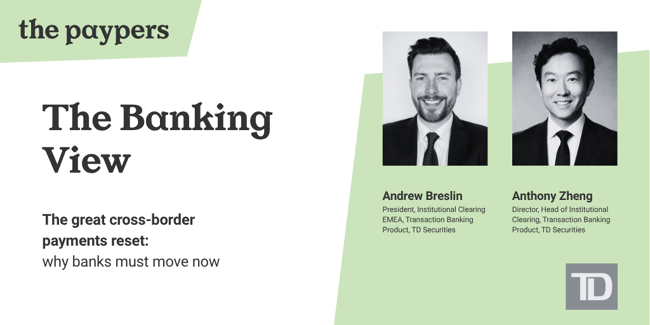
The Banking View | The great cross-border payments reset: why banks must move now

Oana Ifrim
25 Sep 2026 / 8 Min Read
TD Securities explores how cross-border payments are evolving and why modernisation is key to retaining customer relationships.
Key takeaways
Cross-border payments are entering a period of structural change not seen since the introduction of SWIFT standards and the global correspondent banking network. Regulatory pressure, new payment schemes, real-time settlement capabilities, fintech competition, and rising client expectations are converging to force banks to rethink cross-border payments.
Historically, large banks have enjoyed stable revenue flows from cross-border payments, benefiting from scale, correspondent networks, liquidity strength, and trusted client relationships. These advantages remain valuable, but they must now be supplemented by faster execution, richer data, modern infrastructure, and a sharper focus on client experience. Corporate, institutional, and retail clients increasingly expect payments to be faster, cheaper, more transparent, and available around the clock, regardless of geography.
Banks that do not accelerate investment into modernising their technology infrastructure risk being relegated to infrastructure providers, as customer relationships potentially migrate to fintechs, payment specialists, and technology platforms that address critical client pain points. The risk for banks is clear: modernise or risk losing ownership of the customer relationship to other providers.
Industry landscape
The competitive environment for cross-border payments has been fundamentally altered by the emergence of technology-led specialists. Consumer payment experiences are raising client expectations, making multi-day cross-border settlement increasingly difficult to justify. As domestic real-time payments see rapid uptake in enabled markets, exemplified by the doubling of US RTP volumes in just 18 months, pressure can be expected to mount to deliver similar speed across borders, particularly from businesses with significant cross-border flows, where payment timing impacts profitability. Banks therefore need to modernise the end-to-end payment journey, not only the bank-to-bank leg, if they want to remain relevant in a world where real-time or near-real-time flows become the standard.
Fintech providers have exploited the relative weaknesses of traditional cross-border payments solutions by building propositions to address their limited transparency, complex pricing, slow settlement, restricted operating hours and fragmented customer experiences. Rather than replacing banks, they are capturing the parts of the value chain where clients experience the greatest friction.
Regulatory momentum is reinforcing this shift. Globally, regulators are pushing for greater transparency, lower costs, faster settlement, stronger sanctions, AML controls, and improved interoperability. Faster and more efficient cross-border payments are increasingly viewed as a strategic policy objective, not simply a commercial preference.
This pressure is being matched by a significant infrastructure investment cycle. ISO 20022 adoption, the expansion of instant payment networks and so-called "One Leg Out" allowances, enhanced tracking capabilities, cross-border interoperability initiatives, tokenised settlement models, and central bank digital currency experimentation are all reshaping the payments landscape.
Large traditional banks still process the final leg – getting funds into the accounts of the final beneficiary - of most cross-border payments, but that position is changing quickly as new infrastructure, fintech propositions and client expectations reshape the value chain. That shift is why banks' historic advantages – trust, liquidity, infrastructure, and data – while still important, need to be mobilised more effectively.
One of the greatest threats facing banks is not necessarily disintermediation of payment infrastructure, but disintermediation of the customer relationship. If banks fail to modernise, technology-led specialists could continue to play an increasingly prominent role in the client experience, while banks risk losing their position at the centre of the customer relationship.
For banks, this risk is not theoretical; it is directly linked to how they build clearing products, expand network access and deliver international payment capabilities. Modernisation through richer data, stronger interoperability, and more transparent execution is key to ensuring that banks remain embedded in the payment experience they still help enable.
Why large banks remain structurally important
Trust remains one of the most valuable assets in payments. Public sector organisations, multinational corporates, and regulated institutions continue to prioritise stability, financial strength, regulatory oversight and operational resilience. Large banks have endured wars, pandemics, and financial crises; that resilience should not be discounted when clients are deciding whom to trust with critical money movement.
Banks also have infrastructure and data capabilities that newer entrants lack. They process high-value flows across multiple currencies and jurisdictions, manage liquidity across complex corridors, operate within mature control environments, and track payment data that can improve routing, reduce exceptions, and create a more predictable client experience.
Large banks have an opportunity to not only acquire new clients but retain existing relationships by continuing to improve and innovate payment services as expectations evolve. The industry’s largest banks have worked hard to build the trust, liquidity, infrastructure, regulatory expertise, data, and client relationships required to shape the next generation of cross-border payments. Recent evidence points to a clear bank trust premium. As an example, a 2026 study by the American Bankers Association showed US consumers trusted banks to protect them from fraud by a 5-1 margin over the next closest industry.
The real question is whether banks can mobilise their strengths fast enough in an increasingly innovative and fast-paced market. Time is becoming a decisive factor.
What banks must do now
Build for ecosystem scale
No single institution will own the future payments ecosystem. Banks should evaluate strategic partnerships with fintech providers, payment networks, market infrastructures, and technology platforms. The objective should be capability acceleration rather than capability duplication, allowing banks to combine their core strengths with external innovation.
Fintechs and technology providers can often move faster than banks, while banks bring scale, trust, liquidity, controls, and an established client base. Effective partnerships, therefore, can create value on both sides: banks gain speed and innovation, while partners gain access to trusted networks and deep client relationships. Consortia can bring banks, networks, platforms, and market infrastructures together around a shared objective: making the customer experience simpler, faster and more efficient.
TD’s participation in the SWIFT payments scheme as a gateway intermediary into Canada is a practical example of this strategy in action. It connects TD’s correspondent banking strengths, clearing network strategy, and product development agenda with emerging global payment infrastructure.
At the same time, TD continues to invest in modernising its payment infrastructure to enable richer data, greater payment-rail interoperability, faster processing, and more resilient cross-border capabilities. By combining this internal modernisation with its correspondent banking strengths, TD can help deliver faster, more transparent, and more interoperable cross-border payment services for clients.
Activate the data advantage
In his 1597 collection of essays entitled "Sacred Meditations", Sir Francis Bacon observed that “knowledge itself is power”. More than four centuries later, banks process billions of cross-border payments per day, offering powerful data points across flows worth trillions of dollars. Artificial Intelligence offers the opportunity to more easily convert this data into insights and knowledge to drive better decisions, build stronger controls, and offer more intelligent payment services. Industry-wide enhancements such as ISO 20022 offer another potential catalyst for change.
ISO 20022 should be viewed less as an implementation challenge and more as an enabler. Institutions that can effectively use the richer payment data available as a result of ISO 20022 standards can improve compliance screening, fraud detection, client analytics, operational efficiency, and routing decisions. AI will become critical to this, improving how data is captured, structured, validated, interpreted, and acted upon across the payment lifecycle to create meaningful outcomes for clients.
To make this operational, banks should build data controls into the payment journey itself: validating instructions before initiation, enriching incomplete fields at source, monitoring repair rates, and using ISO 20022 data to improve routing, compliance outcomes, and service reporting. The objective is to turn better data into fewer delays, lower exception costs, and a more predictable client experience.
Modernise the experience
Banks must also simplify the client experience. Clients should not need to understand payment rails, correspondent networks or settlement mechanisms; their concerns centre on ensuring the speed, transparency, cost, and reliability of their payments. The institutions that abstract complexity while maintaining resilience and control will be best positioned to win market share.
Banks must move beyond traditional settlement models and invest in real-time cross-border capabilities. This means supporting 24/7 processing, faster settlement windows, enhanced visibility, and end-to-end tracking. SWIFT data shows that 75% of payments over its network reach beneficiary banks within 10 minutes, yet more than 80% of the average end-to-end payment journey is spent in the last mile between arrival at the beneficiary bank and credit to the end account.
For banks' international clearing teams, the challenge is to translate rising customer expectations around transparency, speed and price into better product design, network coverage, settlement models, and operational resilience. Commercial customers could then be confident that their payments will be sent and received on time, allowing them to focus on running their businesses.
Finally, leading banks view payments as a strategic business rather than a supporting product or a cost centre. Payments increasingly serve as a tool for client acquisition, retention, and relationship building. Institutions that view payments as strategic infrastructure rather than a product line will be better positioned for long-term success.
In practice, this means integrating payment modernisation into broader client conversations and prioritising investment in areas that improve client outcomes. Banks must move from defending legacy payment models to actively shaping the next generation of cross-border payments.
Looking ahead
Over the next decade, cross-border payments will continue to become faster, more transparent, more data-rich, more interoperable, and more automated. The fundamental question is not whether change will occur; it is who will lead it.
Progress will likely require collective effort across banks, fintechs, networks, and market infrastructures. Banks still need to keep adapting if they want to improve and keep pace with the industry as a whole.
Large banks typically possess the scale, trust, liquidity, and client relationships required to remain at the centre of the ecosystem. However, these advantages will count less without faster investment, clearer execution and a sharper focus on client experience. Institutions that act decisively today can strengthen their position as primary payments providers. Those that delay risk becoming less-important participants in a market they once led.
The winners will not necessarily be the institutions with the largest balance sheets, but those that move efficiently to combine trust, technology, and client experience into a modern cross-border payments proposition.
This interview is part of The Banking View, The Paypers' series featuring senior bank executives on the payments and regulatory challenges their institutions are working through. Read all Banking View interviews.
About the authors

Andrew Breslin is Vice President, Institutional Clearing EMEA at TD Securities, where he is responsible for expanding the bank’s international clearing products, correspondent banking network, and cross-border payment capabilities. Based in London, he focuses on expanding payment modernisation and market connectivity across EMEA, helping clients navigate the evolving landscape of global payments, settlement, and financial market infrastructure.

Anthony Zheng is Director, Head of Institutional Clearing at TD Securities, where he leads the strategy and development of the firm's institutional clearing capabilities, including Canadian dollar and global foreign-currency clearing. He brings expertise across transaction banking, correspondent banking, payments, liquidity, and cross-border market access. A published contributor and frequent speaker, Anthony is recognised for his perspectives on global clearing and financial market infrastructure.
About TD Securities

TD Securities is a leading corporate and investment bank. Operating from 30 cities globally, we offer capital markets products and services to corporate, government, and institutional clients. Our services include underwriting and distributing new issues, providing advice and industry-leading insight, extending access to global markets, and delivering transaction banking solutions.

The Paypers is a global hub for market insights, real-time news, expert interviews, and in-depth analyses and resources across payments, fintech, and the digital economy. We deliver reports, webinars, and commentary on key topics, including regulation, real-time payments, cross-border payments and ecommerce, digital identity, payment innovation and infrastructure, Open Banking, Embedded Finance, crypto, fraud and financial crime prevention, and more – all developed in collaboration with industry experts and leaders.
Current themes


No part of this site can be reproduced without explicit permission of The Paypers (v2.7).
Privacy Policy / Cookie Statement
Copyright