The Banking View | ISO 20022: why 2026 may be the real inflection point – HSBC

Oana Ifrim
24 Apr 2026 / 11 Min Read
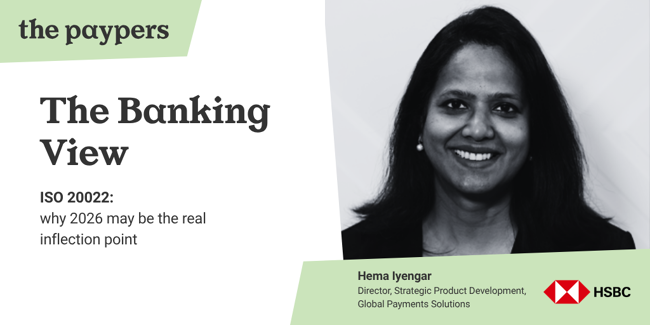
Hema Iyengar, Director of Payment Programs, Global Payments Solutions, HSBC: ISO 20022 hits its inflection point in 2026, when end-to-end structured data enables automation, faster reconciliation, and real-time payment visibility.
ISO 20022 did not emerge overnight. It represents the culmination of more than 60 years of evolution in financial messaging, driven by a shared ambition across banks, regulators and industry bodies to create a common language for payments.
At its core, ISO 20022 is a global messaging standard designed to improve how financial information is structured, transmitted and understood. Unlike legacy formats, which relied heavily on limited fields and free text, ISO 20022 introduces rich, structured and extensible data models that can be used consistently across domestic and cross-border payment systems.
What makes ISO 20022 unique is that it has always been a community-led initiative. The industry collectively recognised that fragmented standards were holding back efficiency, transparency and innovation. The shift to ISO 20022 was therefore not simply regulatory compliance; it was a deliberate step toward a more interoperable and data-driven financial ecosystem. For corporates, the payoff is fewer exceptions, faster reconciliation, and better cash visibility once the data is consistently structured end-to-end.
Today, that vision is beginning to materialise. Interoperability between cross-border frameworks, such as cross-border payments market practice guidelines, and domestic payment schemes is opening new corridors for faster, more seamless movement of money across markets. What was once seen as a technical upgrade is now revealing itself as a foundational transformation.
From migration to modernisation
The early phase of ISO 20022 adoption has been about coexistence and continuity. Financial institutions have had to ensure that new ISO messages can interact with existing infrastructure. This approach has allowed banks to meet global deadlines while maintaining operational resilience.
ISO 20022 messages are significantly richer and more structured than their predecessors. They carry substantially more data - not just payment instructions, but contextual information that can improve compliance, reconciliation and reporting. Processing this data requires new layers of technology, new validation logic and new operational workflows.
In many cases, institutions and market infrastructures prioritised building the connective layer necessary to comply with global standards, particularly those driven by SWIFT’s cross-border payments roadmap. Core modernisation often had to follow later, given the scale of investment required.
However, even at this stage, early operational impacts are already visible. The introduction of structured data has begun to eliminate ambiguity in payment information, reducing false compliance hits and enabling faster processing. Payments that previously required manual intervention due to unclear or incomplete data can now move more smoothly through the system, improving tracking and enabling more efficient operating models.
Why 2026 changes the equation
The introduction of hybrid addresses and fully structured data flows across the correspondent banking chain will fundamentally change how payments are tracked, reconciled and managed.
Today, a payment may travel through multiple intermediary banks before reaching its final beneficiary. If something goes wrong - for example, an incorrect field, a missing identifier, or a compliance query - tracing and resolving the issue can be slow and manual. Data may be incomplete or embedded in free-text fields, limiting automation.
With ISO 20022 fully embedded end-to-end, payment data becomes standardised and machine-readable across the entire chain. Hybrid addressing improves clarity around counterparties. Structured remittance information enables faster, automated reconciliation.
For corporate treasurers, this is not an abstract improvement. It directly affects working capital.
When reconciliation can occur in near real time, liquidity can be unlocked faster. When remittance information is standardised, operational friction decreases. When data quality improves, exceptions decline.
In short, ISO 20022 transitions from being a compliance cost to a strategic enabler.
The data dividend
The most significant long-term value of ISO 20022 lies in its data richness.
Richer, structured data enables automation at scale. Straight-through processing becomes the norm rather than the exception, reducing reliance on manual repairs and enabling institutions to handle higher volumes - even during peak periods or market stress.
Structured data also improves accuracy in financial crime detection. With dedicated fields for parties, addresses and identifiers, screening processes become more precise, reducing false positives while strengthening compliance outcomes.
At the same time, the shift away from free-text messaging toward standardised formats enables fully automated exception and investigation workflows. Requests for returns, recalls or repairs can be processed through structured messages, allowing for faster resolution times, reduced manual intervention and greater transparency for clients.
In this sense, ISO 20022 is not just about messaging. It is about redefining the operational architecture of cross-border payments.
Tangible benefits for corporate clients
While much of the early value has been internal to banks, the next phase will deliver direct, measurable benefits to customers. One of the most immediate improvements comes from structured address data. Dedicated fields for creditor, agents and debtor information significantly reduce errors and false compliance flags, minimising the back-and-forth between banks and clients and accelerating payment processing.
In receivables management, structured remittance data, such as invoice and order numbers, allows ERP systems to automatically match incoming payments to outstanding invoices, reducing manual reconciliation efforts and improving cash application rates.
Liquidity management is also transformed. With improved visibility into payment flows, organisations can develop real-time, intra-day liquidity insights, enabling better cash flow forecasting and more informed financial decisions.
Benefits for banks
For financial institutions, ISO 20022 unlocks both efficiency gains and strategic advantages.
Enhanced data enables automated reconciliation of correspondent accounts, reducing the need for manual matching and allowing discrepancies to be identified and resolved more quickly.
Straight-through processing reduces repair rates and increases scalability, enabling banks to handle volume surges driven by seasonal demand or market events without proportional increases in operational effort.
The real inflection point
2026 is the point where ISO 20022 truly starts becoming end-to-end. Early migrations focused on coexistence and translation so payments could keep moving. By 2026, as more banks process ISO 20022 natively and market practice around structured and hybrid addressing matures, the data will be increasingly preserved across the correspondent chain. That’s when structured party and remittance data starts to deliver consistent operational outcomes - fewer repairs, more automated investigations, and faster processing of payments for corporates.
ISO 20022 was never meant to be a short-term upgrade. It is a foundational shift in how financial information moves across borders. When hybrid addressing, structured remittance data and standardised exception handling converge across global payment flows, 2026 will mark the moment ISO 20022 moves from infrastructure project to strategic catalyst.
Change management: the often-overlooked lever
Delivering the full value of ISO 20022 requires more than technology. It demands effective change management. Successful transformation depends on a number of objectives and outcomes. These include: strong governance and risk management frameworks, and alignment across stakeholders, regulators and markets. It also relies on comprehensive communication and training as well as careful analysis of current systems using real production data.
A strategic imperative for the industry
The scale of industry investment in ISO 20022 reflects a collective recognition that the future of payments depends on interoperability and data quality.
As the 2026 milestone approaches, the narrative must shift from technical compliance to measurable client outcomes - faster reconciliation, improved transparency, reduced exceptions, and enhanced liquidity management.
Institutions that successfully make this transition will not only help improve efficiency for clients but also strengthen their competitive positioning in a market increasingly shaped by digital-first expectations.
This contribution is part of The Banking View, The Paypers' series featuring senior bank executives on the payments and regulatory challenges their institutions are working through. Read all Banking View contributions.
About Hema Iyengar

Hema Iyengar is Director, Strategic Product Development, Global Payments Solutions, HSBC. Her focus is on developing and commercialising transformative capabilities across payment products and solutions. Recent key contributions have been in the development of Real-time Payment's across multiple markets, establishing and executing ISO strategy through market evolution phases and Payments Modernisation. Previously, Hema held leadership roles in Global Payment Operations management and was involved in defining and building a Global Target Operating Model for Payment Operations. Additionally, she also managed regional functions, including Client Onboarding and Payments Processing. Prior to joining HSBC, Hema was at Citi working across multiple geographies. She graduated with a major in Accountancy from Mumbai University along with a specialisation in Systems and Information Management.
About HSBC Holdings plc

HSBC Holdings plc, the parent company of HSBC, is headquartered in London. HSBC serves customers worldwide from offices in 56 countries and territories. With assets of USD 3,233 billion at 31 December 2025, HSBC is one of the world’s largest banking and financial services organisations.

The Paypers is a global hub for market insights, real-time news, expert interviews, and in-depth analyses and resources across payments, fintech, and the digital economy. We deliver reports, webinars, and commentary on key topics, including regulation, real-time payments, cross-border payments and ecommerce, digital identity, payment innovation and infrastructure, Open Banking, Embedded Finance, crypto, fraud and financial crime prevention, and more – all developed in collaboration with industry experts and leaders.
Current themes


No part of this site can be reproduced without explicit permission of The Paypers (v2.7).
Privacy Policy / Cookie Statement
Copyright