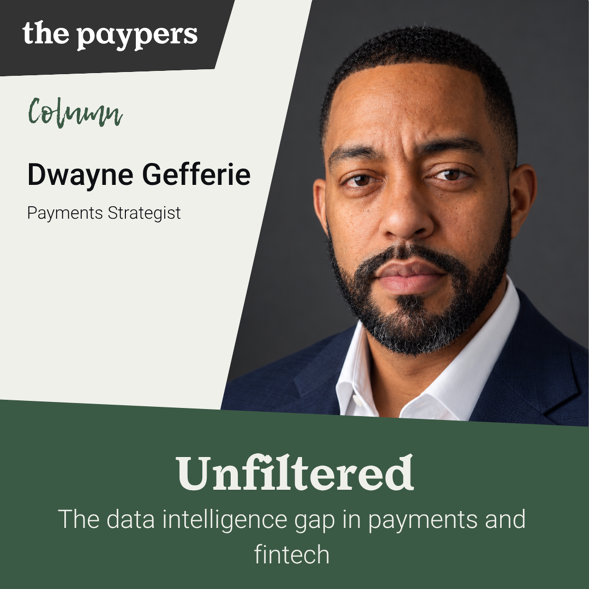
Unfiltered: the data intelligence gap in payments and fintech

Dwayne Gefferie
27 May 2026 / 10 Min Read
In payments, most companies calling themselves ‘AI-powered’ are running glorified rule engines and marketing them as intelligence. That's not a hot take but reading what the data says, and if you work in this industry, you probably already know it's true. You just haven't heard anyone say it in a place where it might make someone uncomfortable.
This column is that place.
I'm Dwayne Gefferie. I've spent 22 years in payments across strategy, data science, and applied machine learning (ML), working with issuers, processors, and acquirers. I've built the models, cleaned the data, and sat in enough rooms to know the difference between a company with real intelligence in its stack and one that has a vendor integration and a press release. ‘Unfiltered’ is my monthly column for The Paypers: one thesis, backed by data, no corporate politeness. If that sounds useful to you, stick around.
Here's the first thesis of the series: 2026 is the year the payments industry stopped being about moving money and started being about the intelligence around it. Most of the industry isn't ready.
The numbers on intelligence adoption don't lie; the narratives do
- Mastercard: Q1 2026 – net revenue up 16% and value-added services up 22%
- Visa: fiscal Q2 2026 – revenue up 17%, hitting USD 11.2 billion and value-added services up from 28 to 32%, reaching USD 3.2 billion.
Notice the pattern? At both networks, the intelligence, fraud prevention, authentication, data insights, and advisory layer is growing far faster than the core business: moving transactions across rails. The two most powerful payments companies on the planet are making more of their margin by thinking about money rather than moving it.
Now ask yourself: if that's where the value is migrating, how many companies in the payments ecosystem actually have the infrastructure to compete? Not a lot, and this is the actual gap.
The real divide: what is actual intelligence in payments?
The payments industry loves to talk about AI at every earnings call, conference keynote, or product page. But there's a difference between intelligence and the appearance of intelligence, and most of the industry is hoping you won't notice.
Real intelligence is built into the platform and learns from every transaction, compounding over time, not in a separate module with its own P&L that someone will cut during the next cost review. Real intelligence is why one company can optimise authorisation rates in real time, while another is still running static rules that haven't been updated since their last annual review.
I've seen this from the inside. More than 20 years ago, at the start of my career at an issuer, I watched expansion decisions get made on gut feeling. Although the data existed, nobody used it. A decade later, while working at Adyen as their first data scientist, I saw what happens when you do the opposite. We changed how interchange and scheme fees were calculated, not as an accounting exercise but as an optimisation; built systems that decided which acquiring connections to launch based on real-time data instead of intuition; and implemented ML directly into the platform's fraud prevention and optimisation stack, not as an add-on but as native intelligence inside every transaction.
That experience taught me something I haven't been able to unsee: when ML is native to the platform, it compounds, while when it's bolted on, it stagnates – most of the industry bolted it on.
Who actually has intelligence in payments?
The companies that made the right investments over the last decade are now separable from the pack by their financials alone:
- Adyen targets 20% annual net revenue growth with EBITDA margins above 50%,
- Stripe hit USD 159 billion in its February tender, processing nearly USD 2 trillion in volume, and its leadership says an IPO would be ‘a solution in search of a problem’,
- Revolut is building its financial platform with data-native architecture at its core.
These companies didn’t buy intelligence through an acquisition, but they built it transaction by transaction and model by model over the years.
On the other hand, the earnings speak for themselves. Merchant services revenue is declining. We see EBITDA margins compressing, businesses divested, and strategic reviews initiated. Companies that defined European acquiring a few years ago are now selling off the regions they expanded into, hoping that getting smaller and more focused will fix what getting bigger didn't.
Payments and fintech M&A activity and what it means
If you want to know where a company stands on the intelligence gap, don't read their strategy slides but their acquisition announcements.
- Visa acquired Featurespace, a UK-based AI fraud detection company, for a reported GBP 700 million. Featurespace's ARIC Risk Hub uses adaptive behavioural analytics, trained on real-time transactional data, to detect fraud across 180+ countries. Visa bought the intelligence it couldn't build fast enough on its own, not volume.
- Mastercard acquired Recorded Future for USD 2.65 billion, its largest acquisition ever, and Recorded Future isn't even a traditional fraud vendor but an AI-powered threat intelligence platform that maps cyber risks, dark web activity, and emerging attack vectors before they become fraud. Apart from a better fraud engine, Mastercard actually bought the ability to see threats forming before they hit the payment rails, showcasing a different level of intelligence ambition, and the price tag shows how seriously they take this gap.
- Worldpay acquired Ravelin, an AI-native fraud prevention platform, in early 2025. Ravelin's cloud-based ML models handle payment fraud, account takeover, and abuse detection for ecommerce merchants. Like the other two, Worldpay bought the capability it needed faster than it could build.
Three of the biggest names in payments have all acquired intelligence within the same twelve-month window. Visa strengthened its value-added services stack, Mastercard expanded intelligence beyond fraud into predictive threat awareness, and Worldpay added native fraud prevention to its ecommerce offering ahead of its merger with Global Payments.
These developments are not mere coincidences but patterns that confirm the thesis: intelligence is where the value is, and if you don't have it, you're writing checks to someone who does.
Three forces are worsening the payments intelligence gap
What makes 2026 an inflexion point is that three things are happening at once, and each one punishes companies that faked it on intelligence.
Agentic commerce is coming, and it doesn't care about your sales team
Visa's Jack Forestell called the agentic web the biggest opportunity in over 20 years of payment tech. Mastercard built Verifiable Intent with Google, and the protocol wars are already underway: ACP, UCP, x402, MCP. But what matters for this argument is that AI agents don't evaluate payment providers as human buyers do, and they don't care about your brand, relationship manager, or hospitality suite at Money20/20. What matters is whether your API is clean, your data is structured, and your authorisation logic is machine-optimised. If your gains relied on distribution rather than technology, agentic commerce is the moment that stops working.
Stablecoins are becoming a real settlement infrastructure
The GENIUS Act, signed last July, is being operationalised fast. OCC, FDIC, and the Treasury issued proposed rulemaking in the first four months of 2026. Moreover, Visa's stablecoin settlement pilot reached USD 7 billion in annualised run rate, up 50% quarter over quarter, across nine blockchains. This isn't a crypto experiment anymore but a question of whose architecture is modular enough to settle across fiat, stablecoin, and real-time rails without a rebuild. As platform intelligence grows in importance, companies that hard-coded their settlement logic ten years ago have a problem.
Transactional data is becoming the leverage money can't buy
Transactional data is the force I'm watching closest, because it's the one I understand as a data scientist and the one the industry understands least. Payments ML has evolved from static fraud rules to adaptive behavioural models to now foundational models trained on transactional data.
Think of it this way. A fraud model trained on one merchant's transactions can spot anomalies for that merchant. A foundational model trained across millions of merchants, billions of transactions, and hundreds of markets can understand what normal looks like at a level no single-merchant model ever could. It can generalise and transfer what it learned in one context to another.
The companies that have been collecting, structuring, and learning from such data for a decade have an asset that no acquisition can replicate. You can buy a processor, a gateway, and even a Featurespace, a Ravelin, or a Recorded Future, yet you cannot buy ten years of clean, model-ready transactional data. That's the real advantage.
Where does this go for payment companies?
The companies with real intelligence in their platforms will keep compounding. Their fraud rates will decrease, their authorisation rates will increase, their ability to serve agentic commerce, and settle across new rails will improve quarter by quarter, because that's what compounding intelligence does.
The companies running glorified rule engines will face a choice: build, buy, or accept that they're becoming infrastructure utilities on which someone else's intelligence layer sits. Most will try to buy, and some of those acquisitions will work, but most won't. Because you can acquire a team, but you can't acquire the data they trained on, and you can't shortcut the years it took to make that data useful.
Strip away the marketing, the partnerships, and the conference appearances. What does your company's payments stack actually know? If the honest answer is ‘not much’, you're on the wrong side of the gap, and the gap doesn't close, it compounds.
About the author

Dwayne Gefferie is a payments strategist, data scientist, and advisor with over 22 years of experience in the global payments industry. Unfiltered is his monthly column for The Paypers.
News on Payments
Expert views on Payments

The Paypers is a global hub for market insights, real-time news, expert interviews, and in-depth analyses and resources across payments, fintech, and the digital economy. We deliver reports, webinars, and commentary on key topics, including regulation, real-time payments, cross-border payments and ecommerce, digital identity, payment innovation and infrastructure, Open Banking, Embedded Finance, crypto, fraud and financial crime prevention, and more – all developed in collaboration with industry experts and leaders.
Current themes


No part of this site can be reproduced without explicit permission of The Paypers (v2.7).
Privacy Policy / Cookie Statement
Copyright