The Banking View | American Bankers Association: how to win the fight against scams

Oana Ifrim
26 Nov 2026 / 10 Min Read
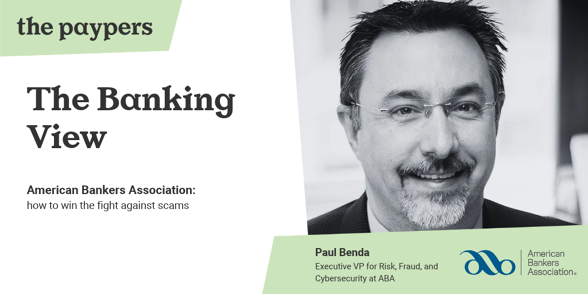
Paul Benda, Executive Vice President for Risk, Fraud, and Cybersecurity at the American Bankers Association, on AI-powered fraud, shared responsibility across banks, platforms, and telecoms, and why prevention must come before reimbursement.
Scams are no longer a side effect of the digital economy. They have become an industry. American victims reported nearly USD 21 billion in internet crime losses to the FBI in 2025, and criminals are using AI to make their schemes cheaper, faster, and more convincing. Paul Benda, who also hosts the ABA Fraudcast and chairs the International Banking Federation’s Fraud and Scams Taskforce, argues that banks cannot stop them alone. He discusses AI-powered fraud, what the US can learn from Australia, the UK, and Singapore, and why he puts prevention ahead of reimbursement.
Paul, given your role within ABA, you play a central role in the industry’s response to fraud. What does your remit cover, and how has it evolved as scams have grown in scale and sophistication?
I’ve got one of the best jobs in the industry. My role is to help our member banks protect themselves and their customers from fraud, scams, and cyberattacks. The biggest shift over the past few years has been towards prevention. For a long time, banks put a huge amount of time and money into securing customer accounts against hacking and takeover. And it worked: banks are now really hard targets. As a result, criminals have changed tactics. Rather than going after the banks, they go after the customers. They pretend to be someone you’d trust, like your bank or a government official, and talk people into handing over their credentials.
The trouble is that banks only come in right at the end of that. We always tell people not to send money to anyone they don’t know and trust. But by the time a customer is about to make that payment, they genuinely believe they do know and trust the person they’re dealing with. By then, it’s usually too late. That’s why we’re now focused on stopping people from engaging with scammers in the first place. You can see that thinking in Australia’s Scams Prevention Framework, which brings telecoms and social media platforms into the effort. We’ve also had a lot of really useful information sharing through the International Banking Federation.
Through the Federation, we get to see what’s working in different places: what the UK has put in place, the European Banking Federation’s work on the EU’s Payment Services Regulation, Australia’s new Scams Prevention Framework, and how Canada is moving forward. Some countries are further ahead in certain areas than others. Our aim is to learn from what works in each one and bring together the most effective approach we can to stop people from getting scammed.
In your testimony before the Senate Special Committee on Aging in July, you said that artificial intelligence is not replacing scams but industrialising them. As we enter the holiday season, which scam typologies concern you most, and how are banks adapting their defences?
What worries us most is how industrialised scams have become. Legitimate businesses are using chatbots that keep getting better at talking to customers, and criminals are doing exactly the same thing. They’re using AI agents to send out millions, even billions, of texts and emails, and a real person only steps in once someone starts to bite. It means they can use technology to generate far more “leads” and reach as many potential victims as possible. They’ve also got much better at impersonation. The scam emails people get today don’t have the typos and clumsy grammar they used to.
They can make an email look exactly like it came from a real company, whether that’s a bank or a delivery firm. That’s why impersonation scams are our biggest concern. In the US in particular, we always see a wave of text scams over the holidays, because people are getting more parcels delivered. You’ll get something like, “Your package is missing, contact us,” and the aim is to get you to hand over your account credentials or your card details. We fully expect that again this year, along with fake websites that look very convincing and are designed to get people to type in their payment information.
Banks are working against all of this constantly, but the sheer scale is going to be tough on consumers. On our side, banks have systems that look for anything unusual. For example, we can see when someone’s using a VPN, when an online card payment is coming from outside the customer’s usual location, and when the timing doesn’t add up. Say a US customer suddenly makes a payment at 3am their time, which happens to be morning in Europe. Is that normal for them? We track all of those signals and weigh them up before letting a payment go through, because ultimately our job is to protect the customer.
The ABA has just relaunched #BanksNeverAskThat, now with a new Scam Slayer initiative, alongside #PracticeSafeChecks. With more than 2,500 banks taking part since the campaigns began, what have you learned about which messages actually change consumer behaviour?
We’ve been running the campaign since 2020, and thousands of banks have taken part. The biggest lesson is that people have scam-warning fatigue. Think about the warnings you see on a peer-to-peer payment app or when you’re buying something online. Most people just click straight through them. That’s why we lean heavily on humour. We use it to teach people what banks will and won’t ask them, to show them they can’t trust what comes up on caller ID, and to make them realise that criminals may already have their personal information when they call. Ultimately, the goal is to raise awareness, get people to pause, and help them spot the red flags.
If someone’s pressuring you, or asking you to keep something secret, it’s a scam. Those are the moments when we want people to stop and think. Measuring the impact, however, is really difficult. Most of what we have is anecdotal: banks telling us about customers who saw one of our videos and then realised something they’d encountered might have been a scam. For that reason, we think the US needs a coordinated national effort, with everyone sending the same message. Above all, that message should be that criminals can have your personal information and can look and sound very convincing. The only way to be sure who you’re talking to is if you started the conversation.
Our main advice, then, is simple. If something feels off, if there’s a sense of urgency or someone is asking you to keep it quiet, hang up. Then call back using the number on the back of your card or the website you’ve bookmarked.
In your Senate testimony, you also called for modernising identity and authentication systems. Why is that so urgent, and what would it look like in practice? And what do you make of the EU’s approach, where every member state must offer at least one digital identity wallet by December 2026?
What we’ve learned is that paper-based credentials aren’t worth the paper they’re printed on, especially now with AI. In the US, opening an account usually means showing some form of ID, like a driver’s licence, along with something like a utility bill as proof of address. AI can now reproduce many of those documents in minutes, and they look completely legitimate. As a result, paper credentials are far less valuable than they used to be. We think a trusted digital identity is the key to moving forward. There are several efforts underway in the US, including mobile driver’s licences and other digital identity initiatives. What really matters is having a trusted source that can be checked in real time and is secured cryptographically.
I really like the direction Europe is taking, with each member state making a digital wallet available. The voluntary aspect is probably important, too. We don’t want to force this on anyone, but it should be there for people who want it. If something like that existed in the US, we’d certainly encourage people to use it, because it lets you prove who you are both in person and online. It would reduce friction and improve security at the same time. That said, it’s important to understand the controls around how a digital ID is shared and who has control over it. That debate is already happening in the US, and I’m sure it will happen in Europe too. Do you have to hand over all of your personal information just to verify who you are? If I only need to prove my identity, do you really need my name, date of birth, address, and everything else?
It will be interesting to see how that plays out in Europe and how much control consumers end up having over their digital identity. Either way, having that capability is really important.
Many scams begin outside the banking system, on social media or through calls and text messages. The SCAM Act would require platforms to verify advertisers, remove scam ads, and accept greater accountability for what appears on their sites. Why does the banking industry see this as a missing piece, and what responsibility should platforms and telecoms companies carry alongside banks?
As we discussed earlier, once a customer has engaged and the criminals have won their trust, it’s very hard for a bank to talk them out of it. There’s also a strong libertarian streak in the US. American customers don’t want their bank telling them how they can and can’t spend their money. There’s really no appetite for a young teller telling an older customer, “No, this is a scam. I know better than you, and you can’t spend your money on this.” That just doesn’t go down well here.
The real question, then, is how we stop people from engaging in the first place. I think it’s a common-sense ask. In our own polling, 96% of voters supported requiring social media platforms to take down fraudulent ads quickly once they’re reported. It’s pretty straightforward. There has been resistance from the platforms, and in our view that’s partly because these ads bring in a lot of money. But everyone needs to do their share to protect consumers. Banks need the right safeguards in place to keep customer accounts secure and make sure people can send money safely to those they know. Online platforms have the same responsibility for their own rails. They need to make sure the ads they’re running aren’t coming from criminals trying to defraud people. Telecoms also have to do better, particularly in the US, at making sure the information shown on caller ID is accurate.
If you bring all of those pieces together, you can start preventing scams rather than trying to recover money after it’s already gone.
Today, no single federal agency leads the fight against scams. If the National Scam Prevention Coordination Act passed tomorrow and created a dedicated fraud and scam prevention office in the White House, what should its first priorities be?
The big one is working out how to share information better across the whole ecosystem. Banks can share some information with each other, within limits, but it’s very hard for us to share anything with telecoms companies or online platforms. The real breakthrough comes when you can tie all of those pieces together. Imagine someone is chatting on an online platform, and a warning pops up in the messenger saying, “You may be in a conversation with a scammer.” Now imagine that warning reaches the bank in real time. We then see the same person adding a new payee, and the telecoms provider tells us they’ve just been on a 45-minute international call. Put all of that together, and you can be all but certain it’s a scam.
With that information, we could stop the payment, or stop them from adding the payee, with a high degree of confidence. Right now, though, banks are flying blind: we only see what happens within our own systems. There are real privacy and technology hurdles to overcome, but we have to find a way to make this work.
Speed is critical in recovering stolen funds. Once a scam payment leaves a customer’s account, it is often moved through multiple accounts within hours, increasingly across borders. In your Senate testimony, you called for better information sharing and faster recovery of funds. What would it take, including legal protection for banks acting in good faith, to freeze and recover stolen money within hours rather than weeks?
Australia is a good example of what’s possible. Its banks built the Australian Financial Crimes Exchange, or AFCX, which runs the Fraud Reporting Exchange, a messaging platform between banks. It lets them report scam payments in near real time, allowing funds to be held and, where possible, recovered. In the US, by contrast, the process varies greatly depending on who’s involved. The scale is also very different. Australia has around 100 banks, while the US has more than 4,000 banks and a similar number of credit unions.
It starts with some basic questions. Can we standardise how freeze requests are issued? What documentation do banks need to stay compliant with current regulations and the law? And what do we need from the customer to put a hold in place? At the moment, we’re doing all of this manually, but we hope to build an automated process similar to Australia’s.
Legal protection is a big part of it. There’s a lot of concern about regulatory overreach when banks are making a good-faith effort to protect consumers. There needs to be some level of trust. If a bank has a process in place, has followed it, and has the right documentation, it shouldn’t be held liable for a wrong outcome caused by something it couldn’t have known.
Overall, I think we should lean more towards preventing the loss of funds than we have in the past.
You have noted that in the UK, banks that had already invested heavily in fraud prevention saw scam losses fall by only 1.5%. Australia, by contrast, shares responsibility across banks, telecoms companies, and digital platforms. Drawing on your work with the International Banking Federation (IBFed), which approach should policymakers in the US and Europe learn from, especially as the EU finalises its own rules?
The UK approach places responsibility entirely on banks, with the sending and receiving banks sharing liability. It also leaves out crypto exchanges and crypto companies, which frankly makes no sense. In the US, more than half of the losses reported to the FBI are now linked to crypto. Why wouldn’t those firms be included? Australia, for its part, is already looking at bringing crypto into its framework. And in the UK, the latest figures show that authorised push payment fraud has actually gone up.
What the UK has really done is change who pays the criminal. It isn’t stopping money from reaching criminals, and that’s where our focus needs to be. I don’t want to argue over who makes the customer whole. I want the criminals not to get the money in the first place. Australia, on the other hand, is making real progress: its scam losses are still well below their 2022 peak. Singapore is another good example. It takes a genuine whole-of-government, whole-of-ecosystem approach, and it’s seeing significant drops in scam losses without that kind of reimbursement scheme. In my view, reimbursement is a misplaced priority. An ounce of prevention really is worth a pound of cure.
Telecoms, social media, crypto firms, and banks all have to take responsibility. Consumers have a role to play too. That doesn’t mean blaming victims, because these criminals can look and sound very convincing. But people do need to stay alert to what they’re engaging with. Our job is to help them do that, and to make sure that when something does go wrong, there’s someone there to step in.
Looking further ahead, as AI agents begin to make payments on consumers’ behalf, what new forms of fraud do you anticipate, and how prepared are banks?
This is a really big challenge, and it’s something we’re debating right now. It’s still early days, and we don’t yet know how agentic AI will change consumer behaviour. The key question is whether consumers really know, and trust, what their AI agent is authorised to do. Say you ask your agent to buy you a bike, and it buys a green one when you wanted red. Is that a scam? Or should the merchant have to refund you, even though you didn’t give the agent clear instructions? There are plenty of questions like that. Here’s another example: you tell an agent to buy the cheapest iPad it can find. We know there are scam sites claiming to sell iPads for USD 10. Will the agent go to one of those sites and buy from it, because it can’t tell it’s a scam?
That’s why we’re urging caution. When you use these tools, you don’t necessarily know how they’ll make decisions or carry them out. Banks are grappling with this, and merchants are too, as they work out how agents will be deployed. We think there need to be clear rules on the authorisation chain for an AI agent and on what counts as a legitimate agent. Agents should also identify themselves as AI when they try to access your information or make a purchase. There’s definitely a role for regulation here, but right now a lot is still unknown.
Personally, I’d be very hesitant to give an AI agent full access to my banking credentials and let it make decisions as it sees fit. You can’t be sure exactly what it will do with that information.
Finally, if you could change one thing in the US fight against scams by the end of 2027, what would it be?
I’d love to find a better way to share information to protect consumers. How do we create a sharing framework that consumers can trust, one that won’t be used to market or advertise to them, but that lets information flow in real time so we can protect them from scams and fraud? Take the example I gave earlier. Imagine you get a warning on an online platform, followed by a pop-up asking, “Do you want to share this with your bank?” You click yes, the information goes to your bank, and the bank knows what to look out for. The same could work with your telecom provider. For this to work, customers would need to opt in and understand what they’re agreeing to, with clear guardrails around any commercial use of the data, so that they can trust it.
If we could get there, we could do a much better job of preventing the loss of funds. That’s really where I think we need to focus.
This contribution is part of The Banking View, The Paypers' series in which leaders and experts from banks and the banking industry around the world share their perspective on the latest developments in payments, fraud, financial crime, and regulation, as well as the evolving needs of their customers and the challenges their institutions are working through. Read all Banking View contributions.
Related in The Banking View:
- Fraud defence with built-in contingencies (https://thepaypers.com/fraud-and-fincrime/interviews/the-banking-view-fraud-defence-with-built-in-contingencies-interview-with-danske-bank);
- Securing the whole payment journey: fraud prevention in the PSD3/PSR era (https://thepaypers.com/fraud-and-fincrime/interviews/securing-the-whole-payment-journey-fraud-prevention-in-the-psd3psr-era)
About Paul Benda

Paul Benda is the Executive Vice President for Risk, Fraud and Cybersecurity at the American Bankers Association. Paul joined the ABA in 2018, where he leads the association’s initiatives in fraud, cybersecurity, physical security, and information security practices and chairs the ABA Fraud Coordination Group. He currently serves as the Chair of the International Banking Federation Scams and Fraud Taskforce.
About ABA

The American Bankers Association is the voice of the nation’s USD 26.5 trillion banking industry, which is composed of small, regional, and large banks that together employ over 2 million people, safeguard USD 20.7 trillion in deposits and extend USD 13.9 trillion in loans.
News on Fraud and Fincrime
Interviews on Fraud and Fincrime

The Paypers is a global hub for market insights, real-time news, expert interviews, and in-depth analyses and resources across payments, fintech, and the digital economy. We deliver reports, webinars, and commentary on key topics, including regulation, real-time payments, cross-border payments and ecommerce, digital identity, payment innovation and infrastructure, Open Banking, Embedded Finance, crypto, fraud and financial crime prevention, and more – all developed in collaboration with industry experts and leaders.
Current themes


No part of this site can be reproduced without explicit permission of The Paypers (v2.7).
Privacy Policy / Cookie Statement
Copyright