Preparing fraud teams for the age of AI and agentic commerce
Paula Albu
02 Oct 2026 / 5 Min Read
Artificial intelligence is redefining online shopping, moving far beyond basic search. What started as basic query assistance is evolving into agentic discovery, where AI agents find products, recommend items, and refer customers directly to checkout.
Fraud is one area to watch closely, as AI is accelerating both attacks and defensive capabilities. What once required coordinated human effort – such as fabricating documents, manufacturing return evidence and scaling attacks – can now be produced and scaled more quickly with widely available generative-AI tools. At the same time, agentic commerce is introducing structural complexity that fraud teams are only beginning to navigate.
In a webinar hosted by The Paypers and moderated by Tracy Kobeda Brown (Fraud Futurist & Global Speaker), three experts discussed what the fraud team of the future looks like: Mark Barlow (CPO at Ravelin), Egemen Ertop (Head of Fraud & Risk Intelligence and AML Expert at Kinguin) and Pablo Stobbia (Payment & Fraud Manager at Pandora).
Tracy framed AI as a double-edged sword: bad actors use it to scale abuse, but fraud teams use it to spot patterns faster and automate workflows. Ravelin’s research sets the scene: two-thirds of merchants have already seen AI-generated fake refund evidence and one in three call AI their biggest fraud challenge (Ravelin’s Global Fraud Trends 2026: Fraud & Payments Survey Report).
The refund problem just got a generative AI upgrade
On Pandora’s side, the pattern many merchants will recognise is clear: Pablo said that, in Pandora’s experience, refund abuse has become a greater concern than card fraud since the pandemic, amplified by generative tools. Pablo described a scenario in which someone seeking a refund on a high-value diamond or gold item returns the wrong product and uses an AI-manipulated photo as supporting evidence. He explained that Pandora looks beyond the image to the wider context, including order history, chargebacks and behavioural patterns.
Kinguin’s side of the same arms race looks different. Operating as a fast-moving digital marketplace for instant delivery, one-time-use codes leave no physical return to fake, so pressure lands on KYC/KYB verification instead. Forged licences used to take seconds to spot manually; today’s AI forgeries are far more convincing. But there’s a silver lining: the technology is ‘poisoning the cure’ at the same time, as the same AI tools used to fake a document can also be deployed to detect the forgery.
Ravelin’s own 2026 research grounds the scale of the shift: 65% of consumers agree AI has made refund abuse easier and 55% say it makes the behaviour feel less wrong (Ravelin’s The State of Refund Abuse Report 2026). Countermeasures can include examining image metadata for signs of editing – while recognising that metadata alone is not conclusive – requesting live photos or videos for selected claims, and leveraging graph networks such as Ravelin Connect to link devices, payment methods and other data to expose coordinated refund abuse rings.
Who’s actually buying?
The core challenge is easy to state: knowing whether a human or a malicious bot sits behind a transaction.
Kinguin’s take on this cuts deepest, walking through what checkout used to capture – name, billing address, device fingerprint, geolocation – before the industry stripped fields around 2019/2020 to optimise customer experience, removing key mismatch signals in the process. Agentic commerce threatens what’s left: if a customer never visits the site directly, geolocation and device data may vanish too. Ultimately, this isn't a fraud team problem to solve alone; it's one for the entire payments ecosystem.
As standards such as ACP and Google’s UCP continue to evolve, Ravelin’s approach focuses on capturing available agent and referral signals, verifying agent identity where supported and detecting unattributed or malicious automation.
The objective remains unchanged: approve legitimate transactions and block malicious ones – whether initiated by a human or an AI agent!
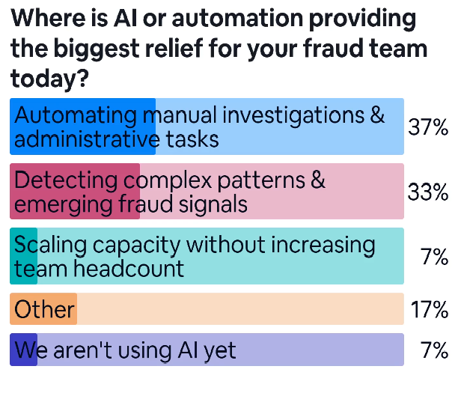
Two live audience polls added clear texture to the discussion:
- Poll 1 (Emerging AI fraud concerns): 50% of respondents named sophisticated bot attacks scaling fraud as their top concern. Synthetic evidence and agentic commerce tied for second place.
- Poll 2 (Where AI provides relief today): ~35% reported that automating manual investigations delivers the most value, followed closely by detecting complex patterns and emerging fraud signals at 33%. Notably, 7% reported not using AI at all – a gap Tracy characterised as both an organisational readiness issue and a real opportunity.
The AI black box dilemma: accuracy, privacy, and human oversight
Despite the clear opportunities that AI capabilities present for fraud teams, opaque systems can create a serious governance problem, particularly when fraud teams cannot understand or challenge consequential recommendations. This lack of transparency is unacceptable for modern fraud teams, who cannot trust or validate predictions when financial risk is on the line. Eyes on the data remain essential.
Building on this, Mark from Ravelin explained that robust guardrails must be established across two critical domains:
- Decision-making guardrails: Organisations should define which AI-assisted actions can be automated and when human review is required. Consequential or uncertain generative-AI outputs should remain explainable, auditable and subject to appropriate oversight.
- Data privacy and scoping: Data security remains under-addressed in many commercial AI implementations. Transmitting sensitive transaction data to unapproved third-party LLMs can create significant privacy, security and governance risks. At Ravelin, AI capabilities are built with strict data scoping controls.
The fraud analyst’s job is being rewritten
Six years ago, this job looked very different: eight hours a day deciding if transaction X was good or bad – stressful, repetitive work. AI has shifted that workload towards genuine analysis and post-transaction monitoring, with an unexpected upside: employee retention has improved as second-by-second operational stress drops.
Both merchants stressed that fraud has outgrown its organisational silo. Fraud teams now work closely with payments, cybersecurity and customer experience to streamline the entire transaction lifecycle. As Tracy put it memorably: ‘Fraud does not respect your org chart.’
On training, the missing ingredient is real guidance: tools are everywhere, but without proper instruction, adoption delivers little value. Over-reliance and complacency are deeper worries. Egemen illustrated this by noting that two weeks earlier, three separate AI tools gave him three different postcodes for his own address, proving why human verification remains critical.
Proactively, Egemen advised fraud leaders to regularly ask themselves how to bypass their own systems so they can catch vulnerabilities before fraudsters do. For junior analysts concerned about automation, Egemen argued that learning how to use and critically assess AI will increasingly be an important skill for fraud analysts. To bridge this gap, Mark suggested pairing analysts on real investigations, agreeing on a gold-standard answer and iterating prompts together to refine context and output quality.
The takeaway
AI here is genuinely dual-use: the same capabilities letting fraudsters fabricate evidence and scale bots are giving fraud teams faster investigations and real relief from constant screening. What decides who wins isn’t the technology alone – it’s training, explainability, guardrails around both decisions and data and cross-team collaboration.
Agentic commerce will only add to this complexity by stripping away data fraud teams have long relied on and no single company can solve that alone. As Tracy closed the session, it’s through collaboration across the whole ecosystem that the industry beats fraudsters.
This webinar recap only highlights the key points of the discussion. For the full insights, watch the webinar recording here.
About the author

Paula Albu has experience in content writing and editing, as well as being a creative storyteller. As a Junior Editor at The Paypers, she investigates Web3 technologies along with the latest trends and regulations in banking and fintech. Paula is committed to turning complex industry topics into engaging, accessible content that resonates with readers and creates a meaningful connection. She is available via LinkedIn or at paula@thepaypers.com.
About Ravelin

AI-native fraud prevention company Ravelin provides technology and support that helps more than 80,000 online companies prevent evolving fraud threats and accept payments with confidence. Combining machine learning, graph networks, behavioural analysis, consortium data, and expert rules, Ravelin has been empowering businesses to draw deeper insights from their data to detect e-commerce fraud and abuse, and increase payment acceptance for 12+ years. www.ravelin.com
News on Fraud and Fincrime
Expert views on Fraud and Fincrime

The Paypers is a global hub for market insights, real-time news, expert interviews, and in-depth analyses and resources across payments, fintech, and the digital economy. We deliver reports, webinars, and commentary on key topics, including regulation, real-time payments, cross-border payments and ecommerce, digital identity, payment innovation and infrastructure, Open Banking, Embedded Finance, crypto, fraud and financial crime prevention, and more – all developed in collaboration with industry experts and leaders.
Current themes


No part of this site can be reproduced without explicit permission of The Paypers (v2.7).
Privacy Policy / Cookie Statement
Copyright