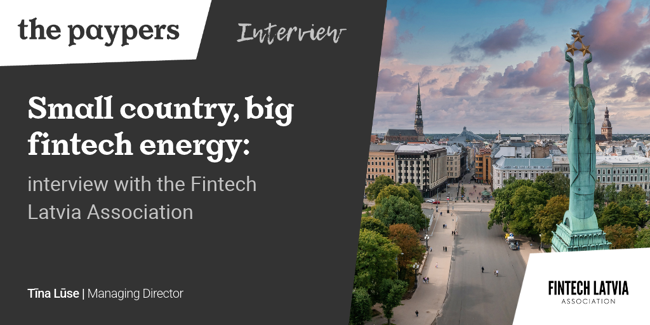
Small country, big fintech energy: interview with the FinTech Latvia Association

Oana Ifrim
19 Nov 2026 / 8 Min Read
'Latvia is no longer only a place where fintechs are born. It is becoming a place where they come to build.'
Tīna Lūse, FinTech Latvia Association
Latvian fintech: trends and what is happening
Latvia has fewer than two million people, yet its fintech sector counted 127 companies in 2024, many of them built for international customers from day one. Tīna Lūse, Managing Director of the FinTech Latvia Association, explains what drives that reach, which trends will shape the sector, and what success should look like by 2027.
What explains Latvia’s outsized presence in European fintech?
Latvian fintech is small at home and big everywhere else. With fewer than two million people, our home market is too small to build a business on, so a Latvian founder plans for Europe from day one, and often for the whole world. Some of our companies barely sell in Latvia at all. Here they hold their licence, employ their people and pay their taxes, while their customers are spread across Europe, Africa, Asia, and Latin America. Building across borders is our defining trait.
The scale surprises people. Our last Fintech Pulse report counted 127 fintech companies in 2024, employing 3,644 people. Together they earned EUR 97 million in profit, more than double the year before, and paid over EUR 91 million in taxes. Yet most of their business happens abroad. Investment platforms licensed in Latvia serve more than 800,000 investors in other countries and have channelled over EUR 13 billion, close to a quarter of Europe's alternative investment market. Riga-based lenders operate on four continents.
Why here? First, people. For decades, Riga has been a regional financial centre, and its banks trained a deep pool of specialists in finance, risk, compliance, and IT. Many of them went on to found or build fintechs, so most of our companies were started by Latvians who brought real banking experience, not just a good idea, plus strong engineering skills. Second, access. Latvijas Banka offers free pre-licensing consultations, and foreign founders are often surprised they can meet the supervisor within days, not months. Third, trust. Latvia was the first country assessed in MONEYVAL's new round and was rated high or substantial on 10 of 11 effectiveness outcomes. When you serve customers across Europe, the reputation of your home jurisdiction is part of your product. And fourth, ambition. A small hub does not mean small ambition: our founders set out to compete in Europe and beyond from the very first day.
This year the combination started to work in the other direction too. Founders from the US, Germany, Austria, Israel, and Poland chose Riga as their EU base: finmid, built by former N26 executives, Austria's pinyya, Israel's Fibonatix, Poland's AlphaRoute and the US-founded crypto platform Backpack, which now holds both a MiCA crypto licence and a payment institution licence from Latvijas Banka. Latvia is no longer only a place where fintechs are born. It is becoming a place where they come to build.
Which trends will shape European fintech most, and where does Latvia have an edge?
AI will change the most, but the Savings and Investments Union (SIU) is where Latvia has the clearest edge.
AI is already part of daily work for our members: in software development, onboarding, fraud detection, compliance, and customer support. A small, experienced team can now build in days what used to take months. In regulated finance, though, speed is only half the story. The principle our industry is settling on is simple: AI prepares, people approve, especially when a decision is about someone's credit or money. Our lenders and payment companies have spent more than a decade building automated, data-driven decisions across many markets, so they start from a strong position, as long as governance keeps up.
The SIU plays directly to our strengths. Europe wants to turn savers into investors, and Latvian platforms already do that for hundreds of thousands of retail investors, with Germany as their biggest market. They are also adapting to what investors want now: more choice and the option to withdraw before a loan matures. If the SIU removes barriers between national markets, Latvian platforms are ready to scale with it.
On banking, the door is now open. Since January, Latvia's specialised credit institution licence lets a company start a bank with EUR 1 million in capital instead of EUR 5 million. Mintos has announced it is pursuing one, and we are speaking with UK investors interested in the same route. Fintechs increasingly see licences as a career path: payment institution, e-money institution, then bank. Not every fintech should become a bank, but those that should can now do it here.
Two more shifts are worth watching. Under MiCA, Latvia has licensed 12 crypto-asset service providers, and several pair that with a payment licence to offer stablecoin payments. And finance is becoming embedded: Latvian banks and fintechs increasingly run lending and payments inside other companies' platforms.
What connects all of this is our habit of building for many countries at once. That is exactly what Europe's next stage of integration rewards.
What would success look like for Latvian fintech, and how will the association help?
Success has a number and a name. The number is in Latvia's Fintech Sector Development Strategy: by the end of 2027, 30% more fintech companies, 15% more investment and 18% more jobs. The name is Riga on the shortlist. When a founder in Singapore, Tel Aviv or New York decides where to enter the EU, Riga should be considered alongside Vilnius, Dublin, and Amsterdam.
But a licence is only the beginning. Success means that companies which come for a licence stay to build teams and products here, and that Latvian companies which scale across Europe keep their headquarters, talent and taxes at home. Growing up also means growing into the capital markets, and our lenders are already there: some of them, Eleving and Sun Finance among them, fund their growth with bonds on the exchange, and DelfinGroup took its shares to Nasdaq Riga in 2021. The next step I would love to see is a licensed Latvian fintech with a truly international business listing its shares in Riga. That would prove the whole journey, from idea to global public company, can happen here.
The association works on three fronts. At home, we speak for the industry in dialogue with the regulator and the government, so that rules are strict where they must be and practical where they can be. Latvia's first equity release lending framework, which we helped develop and which came into force in September, is one result. Abroad, we present Latvia as one ecosystem rather than individual companies. In 2025 and 2026 we joined 10 trade missions and industry events in seven countries, from London to Japan, often together with LIAA, our embassies and the country's top leadership, and we build bridges with other fintech hubs. We have signed memoranda of understanding with partners such as Innovate Finance in the UK and counterparts in Japan and Uzbekistan, and we organise events together: this September, for example, we brought Latvian fintechs to Berlin with the House of Finance & Tech Berlin, together with Latvia's Minister of Economics. Next, we will focus on fewer markets and make sure every trip leads to concrete business. And for the future, we work with universities, so the talent pipeline keeps up, because specialised compliance, risk, and technology experts are now the scarcest resource in our industry.
We called our podcast Small Hub, Endless Opportunities. It is also the best summary of where Latvia stands in European fintech.
Fintech Pulse 2026: what happens on 27 November
Fintech Pulse 2026: Finance of the Future Forum, the FinTech Latvia Association’s annual event, takes place on 27 November 2026 at Forum Cinemas in Riga. The agenda covers licensing, banking, crowdfunding, non-bank lending, sanctions compliance, and talent, and the day closes with the first Fintech Pulse Awards.
How did you choose the agenda, and what does it say about Latvian fintech today?
The agenda simply mirrors our advocacy agenda. These are the issues we work on every day with our members, the regulator, and the government: licences, capital, supervision, compliance, and people. Those are the questions of companies that are scaling, not of startups looking for their first customer. And each of them is changing in the market right now.
Licensing is where it needs to be. Latvijas Banka issued eight fintech licences in 2025 and more than 25 since the start of 2026, without lowering its standards. Our goal is to keep exactly that combination of speed and quality. At the forum, the regulator and companies that have just been through the process will talk openly about what it takes. Banking is the next big theme, and we see it from three directions at once: newcomers from abroad looking at the new specialised banking licence, which needs EUR 1 million in starting capital instead of EUR 5 million; our own fintechs that have grown up and now want to become banks; and banks that are rebuilding themselves to work more efficiently with fintechs. All of these are topics that need an outside view from time to time, so we want a frank discussion about who the licence is for and what the supervisor expects.
We will also show how far Latvian fintech already reaches. Our panel Born Locally, Servicing the World brings together companies that started in Latvia and now scale abroad, across lending, payments, brokerage, and financial literacy. It shows which verticals Latvia already exports and what it takes to grow from Riga into global markets.
Crowdfunding is on the agenda because small businesses still struggle to get bank financing, while our platforms bring European capital into the real economy. Ronald Kleverlaan of the European Centre for Alternative Finance at Utrecht University will look at how crowdfunding can help SMEs grow. Non-bank lending moves under Latvijas Banka's supervision from January 2027, just as new EU consumer credit rules take effect. Lending is one of our largest segments, and it needs clarity early and a seat at the table while the rules are written.
Sanctions compliance is a daily reality for anyone in finance in our region, which is why Alexander Browder, whose Global Cryptocurrency Laundering Database has helped expose sanctions evasion, will join us. And talent closes the loop: companies tell us the problem is not a lack of people but finding precisely the expertise a regulated business needs.
Taken together, the agenda describes a sector moving from growth at any cost to growth that lasts. Latvian fintech is growing up, and it wants the rules, the people, and the infrastructure that a mature industry needs.
Why did the association create Fintech Pulse, and why does bringing everyone together matter?
For years, Latvian fintech was underestimated, partly because nobody had measured it properly. If you cannot show what a sector contributes, you cannot have a serious conversation about policy. Fintech Pulse began as our answer: put the facts on the table first, then discuss what to do about them.
That is still how the forum opens. This year we present the fifth Fintech Pulse report, which for the first time lets us compare five years of the sector's development: companies, turnover, profit, taxes and jobs. Five years of data let us take an honest look at where we are strong and where we still have work to do. Those five years also show how much we have grown up together. The association itself has gone from seven members to more than 50, and the ecosystem around it has grown just as fast. Today we have something to say, and something to offer.
The real value is who is in the room. Practically everyone who does anything in Latvian fintech will be there, across every vertical, from lending and investment platforms to payments and crypto. Santa Purgaile, Deputy Governor of Latvijas Banka, and Ieva Jāgere, Director General of LIAA, will sit alongside founders such as Mārtiņš Šulte of Mintos, and people who chose Latvia from abroad: Thomas Köck, former head of Erste Group's Austrian building society and now co-founder of pinyya, and Max Schertel, one of N26's first employees and now co-founder of finmid. In one day, a founder hears directly what the regulator expects, policymakers hear what slows companies down, and universities hear which skills the industry will hire for. In a small country, that kind of direct dialogue is a competitive advantage, and we intend to keep it. We run smaller events throughout the year where the ecosystem meets, such as our Fintech Breakfasts, but once a year it is worth stopping to measure the results together and set the goals for the next year. That is what Fintech Pulse is for.
We close with the first Fintech Pulse Awards. Our companies compete and win across Europe, yet they are often better known abroad than at home. The awards recognise their contribution to the Latvian economy, international growth and innovation, and show the next generation that world-class fintech is built in Riga.
Fintech Pulse 2026: Finance of the Future Forum takes place on 27 November at Forum Cinemas, Riga. Programme and registration: fintechpulse.io
About Tīna Lūse

Tīna Lūse is the Managing Director of the FinTech Latvia Association, which she has led since January 2021. She represents Latvia's fintech industry in dialogue with Latvijas Banka, government institutions and international partners, and leads Fintech Pulse, the association's annual report and forum on the state of Latvian fintech. She works with the Investment and Development Agency of Latvia to promote Latvia as an entry point to the EU market for international fintech companies and speaks regularly at industry events across Europe.
About FinTech Latvia Association
FinTech Latvia Association (FLA) is the industry organisation of Latvia's financial technology sector. It brings together more than 50 fintech companies, a tenfold increase in membership over five years, including payment and e-money institutions, lenders, investment, and crowdfunding platforms, regtech companies, and crypto-asset service providers. FLA represents the industry in dialogue with government institutions and the regulator, promotes Latvia as a fintech jurisdiction internationally together with LIAA, and publishes Fintech Pulse, the sector's annual report, launched each year at the Fintech Pulse forum in Riga.
Interviews on Fintech

The Paypers is a global hub for market insights, real-time news, expert interviews, and in-depth analyses and resources across payments, fintech, and the digital economy. We deliver reports, webinars, and commentary on key topics, including regulation, real-time payments, cross-border payments and ecommerce, digital identity, payment innovation and infrastructure, Open Banking, Embedded Finance, crypto, fraud and financial crime prevention, and more – all developed in collaboration with industry experts and leaders.
Current themes


No part of this site can be reproduced without explicit permission of The Paypers (v2.7).
Privacy Policy / Cookie Statement
Copyright