The stablecoin opportunity isn’t acceptance, it’s settlement
Paula Albu
13 Nov 2026 / 5 Min Read
For years, the payments industry has asked the same question about stablecoins: will consumers actually use them to pay?
For PSPs, that may be the wrong question.
Despite growing interest in digital assets, crypto remains a relatively small part of consumer payments globally. Established payment methods - from cards and digital wallets to bank transfers and local payment methods - continue to dominate at checkout, with preferences varying significantly between markets.
But stablecoins don't need to replace those payment methods to play a meaningful role in payments. For PSPs, a potentially much bigger opportunity sits behind the checkout: using stablecoins as infrastructure for moving and settling value across markets.
Stablecoins can provide a 24/7 bridge between currencies and markets, giving PSPs another way to move liquidity internationally and connect into existing fiat settlement infrastructure.
The customer still pays in euros, and the merchant still receives dollars, pounds, or pesos. Neither needs to hold crypto, manage a wallet, or even know a stablecoin was involved. The innovation happens behind the scenes, at the infrastructure level.
The problem behind the payment
Traditional international settlement presents several challenges for PSPs. It relies on a network of banks, currencies, intermediaries, and local payment systems. Different markets operate on different schedules. Banks close overnight, at weekends, and on public holidays, and cross-border transfers can pass through several institutions before reaching their destination.
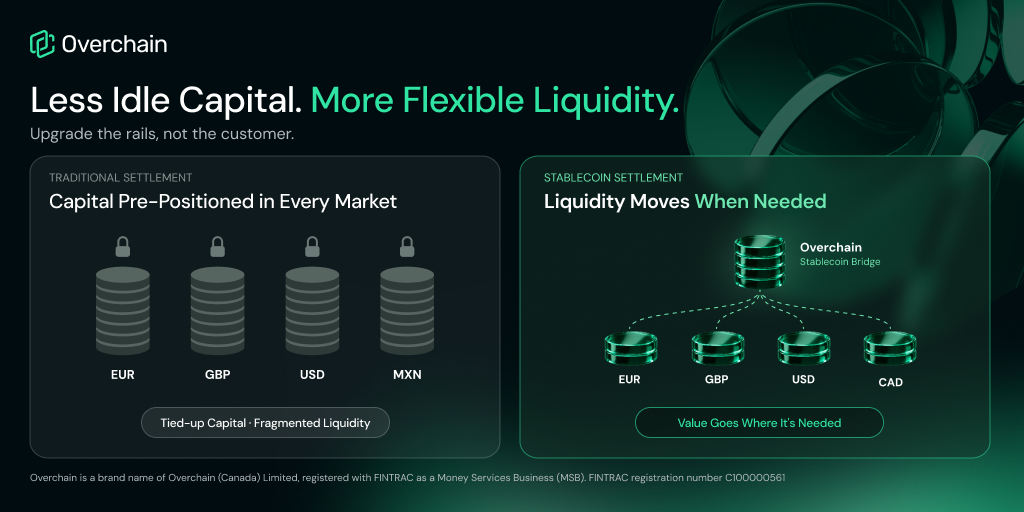
PSPs must also maintain liquidity across different markets to meet local payment obligations, leaving capital sitting idle. For a multi-country PSP, the result is a significant operational burden: fragmented liquidity, slower settlement, extra banking and foreign exchange costs, and capital tied up globally.
The challenge becomes particularly acute as a PSP expands. Adding markets can mean adding currencies, banking relationships, liquidity requirements, and settlement processes. What begins as a payments challenge quickly becomes a treasury and operational one. Stablecoins offer another way to connect those dots.
An invisible bridge
Stablecoins don't have to become a new consumer payment method to be useful.
Imagine a European shopper buying from a merchant that needs funds in another country:
- Checkout: The shopper pays using their preferred method (debit card, credit card, or bank transfer). At this point, nothing changes.
- Transfer: The PSP converts the value into a stablecoin, which can be transferred using blockchain infrastructure.
- Payout: The value is converted back into the local currency required by the merchant.
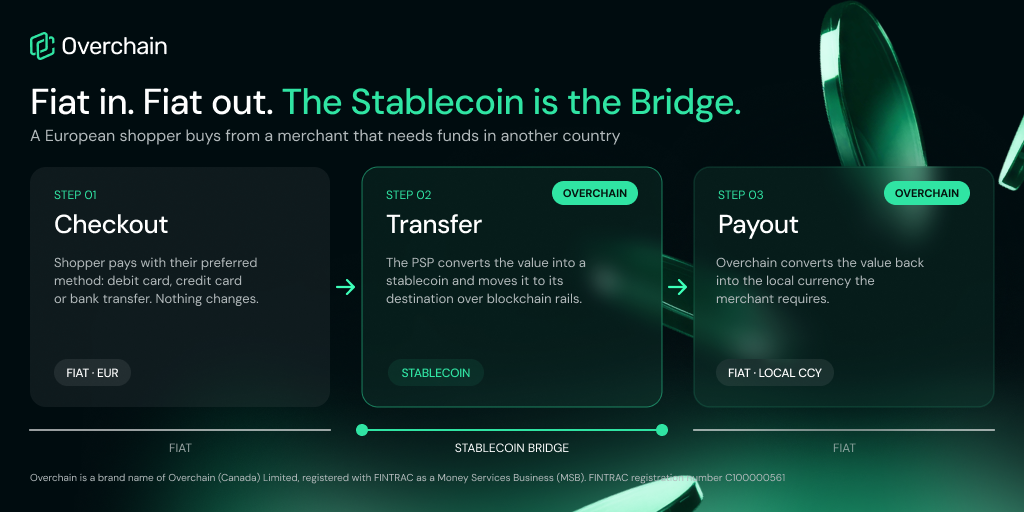
Fiat goes in. Fiat comes out. The stablecoin is simply the bridge in between.
This means PSPs can use stablecoin infrastructure without requiring consumers or merchants to change how they pay or receive funds. Consumers don't need to learn how stablecoins work, merchants don't need to hold digital assets, and neither side takes on direct crypto exposure.
Moving liquidity when needed
For PSPs, one of the most significant implications is capital efficiency.
Traditionally, supporting payments in multiple markets has meant pre-positioning liquidity in different bank accounts around the world. Stablecoin settlement can allow PSPs to move value between markets when needed, rather than keeping large amounts of capital idle in anticipation of future payments.
That can give treasury teams more flexibility in where liquidity sits and how quickly they can deploy it. Instead of relying solely on funds already positioned within a particular market or banking relationship, PSPs gain an additional route for moving value where it is needed.
Beyond capital efficiency, there is speed.
Blockchain networks don't close on Friday evening. They don't observe bank holidays, and they don't care whether the recipient is six time zones away. Stablecoins can move around the clock, potentially giving PSPs much greater flexibility in managing settlement and merchant payouts.
That does not mean every part of the settlement journey suddenly becomes 24/7. Fiat banking infrastructure, liquidity availability, and compliance requirements still matter. Rather, the advantage is that PSPs have another rail available when traditional infrastructure is constrained by cut-off times or market operating hours.
Cost is the third piece of the puzzle.
Cross-border payments often involve multiple intermediaries, each potentially adding fees, foreign exchange spreads, and processing costs. A more direct settlement route can reduce some of those layers, creating opportunities for PSPs to improve margins or offer more competitive pricing.
The rail is only useful if it connects
This is where the conversation around stablecoin settlement needs to move next.
Access to a stablecoin or blockchain network is relatively straightforward. Making that rail operationally useful inside a payments business is harder.
A PSP still needs to determine how funds move between fiat and stablecoins, where liquidity comes from, how transactions are screened, how different networks and wallets are managed, how stablecoin flows connect back into existing banking infrastructure, and how every movement is reconciled and reported.
These processes cannot sit separately from the rest of the payments operation. They need to work alongside the PSP's existing banking, treasury, and compliance infrastructure.
The goal should therefore not be to build a separate “crypto” stack. It should be to make stablecoin rails another part of the infrastructure PSPs can use whenever those rails offer the most effective route for moving money.
Upgrade the rails, not the customer
For PSPs, the opportunity is increasingly practical rather than ideological. Stablecoins don't need to replace existing payment methods to create value. They need to solve genuine operational problems.
That could mean moving liquidity between markets, reducing reliance on pre-positioned capital, extending settlement beyond traditional banking windows, and creating more flexible routes for international money movement.
Making that work at scale requires optimal integration with existing banking, treasury, compliance, and payment infrastructure. That is the gap infrastructure providers such as Overchain aim to close, connecting stablecoin settlement with the banking, treasury, compliance, and operational infrastructure PSPs already rely on, so they can use stablecoin rails without creating another disconnected layer in their payments stack.
The future of payments doesn't require teaching millions of people a new way to pay.
It may simply require giving payment businesses better ways to move the money behind the payments they already process.
About the author

Sam Shields is CEO of Overchain, bringing extensive experience in building and scaling businesses across financial services, fintech, and digital assets.
An established entrepreneur, Sam has led businesses generating over USD 4 billion in trading volume and USD 7 million in annual revenue. At Overchain, he sets the strategic direction of the business, leading its international expansion and long-term growth. His focus is on optimising the institutional adoption of stablecoins and establishing Overchain as a leading provider of financial infrastructure for global money movement.
About Overchain

Overchain is an operating layer for digital money movement. It enables international businesses to receive, convert, move, and settle value faster and more efficiently than traditional financial rails.
The Overchain platform brings stablecoin settlement, treasury orchestration, OTC execution, and compliance tooling into a single operational layer. Payments businesses can receive and send value in stablecoins, automatically converting to or from fiat for settlement through their existing banking infrastructure.
News on Payments
Expert views on Payments

The Paypers is a global hub for market insights, real-time news, expert interviews, and in-depth analyses and resources across payments, fintech, and the digital economy. We deliver reports, webinars, and commentary on key topics, including regulation, real-time payments, cross-border payments and ecommerce, digital identity, payment innovation and infrastructure, Open Banking, Embedded Finance, crypto, fraud and financial crime prevention, and more – all developed in collaboration with industry experts and leaders.
Current themes


No part of this site can be reproduced without explicit permission of The Paypers (v2.7).
Privacy Policy / Cookie Statement
Copyright