The Banking View | From history to high-tech banking: building businesses – and banks – that scale

Oana Ifrim
07 Oct 2026 / 7 Min Read
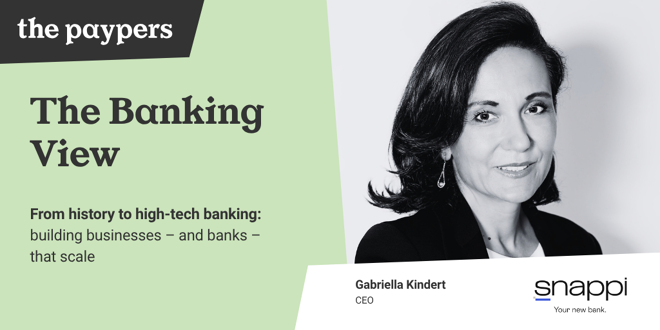
Gabriella Kindert, CEO of Snappi: Greece has the talent, customer readiness, and market opportunity to play an important role in shaping the next generation of banking.
Born in Hungary, shaped by the Netherlands, and now leading Snappi in Greece, Gabriella Kindert brings a historian’s curiosity and an entrepreneur’s instinct to the future of banking. Having built successful franchises, she talks about growth across markets, trust, AI and financial inclusion, and why her family tries to discover three new countries every year.
Gabriella, can you introduce yourself and tell us about your professional background?
I am Dutch-Hungarian, with German roots. I was born in Hungary and moved to the Netherlands in 1993. My story has always crossed borders, and so has my professional life. I studied history and finance/economics, two subjects that still shape how I look at the world.
History teaches you to ask how we got here, and why institutions and people behave as they do. Economics helps explain choices, incentives and trade-offs. Banking brings those questions into everyday life, where decisions affect people, businesses, and the wider economy.
I have always been drawn to building and growing businesses. I have always taken on challenges that others described as 'mission impossible.' Why? I guess I enjoy proving that anything is possible. I was born in communist Hungary, still I have studied and worked in several countries. Over the course of my career, I have built several successful franchises and developed new propositions. What motivates me is taking an idea, creating the team and business model to make it work, and then growing it into something customers value.
I enjoy building businesses with the potential to scale across markets; my ambition has always been international.
I also enjoy proving that, no matter where you come from, you can succeed. Today, as CEO of Snappi, I have the opportunity to help shape a new generation of banking in Greece.
In my personal life, I am married with two children. My daughter is studying in Leiden, and my son attends St Catherine’s in Kifisia, so our family life spans a few different worlds. We also try to visit three new countries every year. It is a good ambition, and an effective way to keep the family negotiating. I raised my children to be very international. Trilingual. Curious.
I also learned to survive in all circumstances. Even when I was ten, my mother described me as someone who could make a living on an iceberg.
Outside work, I am interested in art, music and nature. I also love good food and am fascinated by the connection between nutrition and wellbeing. I am curious about how the choices we make every day shape how we feel over the longer term.
Leading a digital bank in Greece has given you a close view of how quickly consumers here have moved from cash and branches to cards and apps. How would you describe their relationship with money and banks today, and what still makes the Greek market distinctive?
Greek customers have moved quickly towards digital payments. Cards, mobile payments, and banking apps have become part of daily life, and customers increasingly expect financial services to be immediate, intuitive and available wherever they are. Cash remains part of the picture, as it does in many markets, but the direction of travel is clear.
The next opportunity is to help customers do more with their money. Investing and long-term financial planning are not yet as widely embedded as everyday payments, while access to credit can be improved through a better understanding of customers’ real circumstances.
Greece is a particularly interesting market because it combines strong digital adoption with significant scope for innovation. Too many providers have historically competed for similar customers with similar products. The opportunity is to broaden access, bring greater choice, and design services around what customers actually need. That takes more than a new interface; it requires ambition in how banking is built and delivered.
People are increasingly comfortable spreading their finances across several providers. From where you sit at Snappi, how do you expect the balance between established banks and digital challengers to shift in the coming years?
Customers are becoming more deliberate about choosing where they bank. They may use one provider for their main account, another for savings and another for a particular payment or credit need. The relationship is increasingly earned through relevance and service, rather than assumed through habit.
At Snappi, we want to become a valued second bank in our customers’ pockets, then earn the opportunity to become their primary bank. We are building a broader proposition across payments, savings, credit, and investments, alongside products that give customers a compelling reason to engage with us.
That is a long-term undertaking. An app can be launched in a day; a bank cannot. Trust is built through dependable service, sound risk management and products that deliver on their promise. The strongest digital challengers will combine the speed and convenience customers expect with the discipline and reliability a bank must provide.
Technology will drive much of that change. Where do you see artificial intelligence making the biggest difference for everyday customers, and what will it take for people to trust financial decisions shaped by algorithms?
Technology is a means to an end, not a purpose in itself. Its value should be measured by whether it makes people’s lives better and financial decisions clearer.
AI can help customers understand their finances, identify patterns, and receive guidance that is more relevant to their needs. For banks, it can improve the quality and consistency of decisions, including credit assessments. That matters because many people still lack appropriate access to credit, not necessarily because they cannot repay, but because conventional processes may not capture their full financial picture.
Trust will depend on how these systems are designed and governed. Customers need decisions that are explainable, fair, and open to challenge, with clear accountability when something goes wrong. I see AI as a powerful adviser: it can sharpen insight and widen perspective, while human judgment remains essential for responsibility and context. In finance, speed matters, but so does being able to explain the answer.
Digital tools have made financial products easier to access than ever, but not necessarily easier to understand. What role should banks play in improving financial literacy and helping people build healthier long-term money habits?
Financial decisions can be complex, much like decisions about health or legal matters. People should not need to become specialists to make a sound choice. They need clear information, relevant guidance, and confidence that a product fits their circumstances.
Banks have a responsibility to explain products, costs, and risks in plain language, and to do so when a customer is making a decision. Financial literacy is not only about education campaigns; it is also about how products are designed and how choices are presented.
A decision has to be right in practical terms and feel right to the person making it. Our role is to help customers understand their options and make informed choices, without overwhelming them or speaking down to them. Good banking should make people feel more capable, not more dependent.
Looking ahead to the end of the decade, what role do you hope digital banks like Snappi will play in building a stronger, more customer-focused banking system in Greece and across Europe?
I hope digital banks help make banking more open, transparent, and responsive. When customers choose to share their data, they should receive a tangible benefit: more relevant products, clearer decisions, and a fairer assessment of their financial position.
Better data can help lenders distinguish risk more accurately. That can open access for creditworthy customers who have been poorly served by traditional models, while allowing lenders to price risk responsibly. The goal is not simply to make decisions faster; it is to make better decisions and ensure customers benefit from the progress technology makes possible.
I have an international outlook, and I would like to see Greece not only adopt solutions developed elsewhere, but also build ideas and businesses that can influence the rest of Europe. Greece has the talent, customer readiness, and market opportunity to play an important role in shaping the next generation of banking. I would like Snappi to help show what can be built here: a customer-focused bank with the ambition to set a high standard well beyond its home market.
This interview is part of The Banking View, The Paypers' series featuring senior bank executives on the payments and regulatory challenges their institutions are working through. Read all Banking View interviews.
About Gabriella Kindert

Dr. Gabriella Kindert is a banking and investment executive with 20+ years of experience across private credit, leveraged finance, and digital lending, with a track record spanning multiple geographies and market cycles. She is CEO of Snappi Bank, a fully licensed bank building modern, digital-first banking and data- and AI-enabled lending solutions across BNPL, embedded finance, and consumer credit. She is Chair of the Board at Neptune Maritime Leasing, a fast-growing asset-based lending (ABL) platform, and serves as Senior Advisor and Investment Committee member at Credit Value Investments (CVI), a leading private debt platform focused on Central and Eastern Europe (CEE). Her work spans credit strategy, underwriting and portfolio analytics, risk-based pricing, and the responsible use of alternative data to improve customer outcomes. Previously, she held senior leadership roles at BNP Paribas Asset Management and NN Investment Partners, spanning global loan investing, leveraged finance, structured credit, and alternative credit. She is the author of several books on credit and investment topics. She holds an MA in History and Economics, an MBA in Accounting and Finance, and a PhD in Finance.
About Snappi

Snappi is Greece’s first ECB-licensed neobank, created to make banking simpler, more accessible and more human. Launched publicly in 2025, Snappi combines the security of a fully regulated bank with the speed and simplicity of fintech. Through innovative products, 24/7 human customer support, responsible use of AI and a growing ecosystem connecting banking, technology and financial wellbeing, Snappi aims to help people feel more confident about their financial lives every day.
Interviews on Payments

The Paypers is a global hub for market insights, real-time news, expert interviews, and in-depth analyses and resources across payments, fintech, and the digital economy. We deliver reports, webinars, and commentary on key topics, including regulation, real-time payments, cross-border payments and ecommerce, digital identity, payment innovation and infrastructure, Open Banking, Embedded Finance, crypto, fraud and financial crime prevention, and more – all developed in collaboration with industry experts and leaders.
Current themes


No part of this site can be reproduced without explicit permission of The Paypers (v2.7).
Privacy Policy / Cookie Statement
Copyright