For years, EMEA merchants have treated fraud prevention, payment processing, and authentication as three separate disciplines, each with its own vendors and owners. In a recent webinar hosted by The Paypers, moderated by financial journalist Joy Macknight, Shelly Assaf, Senior Product Manager at Riskified, and Adam Vissing, VP Sales and Business Development at IXOPAY, argued that this model has quietly been failing merchants, and that in 2026, it’s no longer defensible.
Here are a few of the highlights:
The silo problem
Adam Vissing explained why the traditional separation is breaking down: the assumption that fraud, payments, and authentication have clean boundaries was never quite true, and attackers now deliberately probe the seams between disconnected tools. He described orchestration platforms as the connective tissue linking these domains, now table stakes for any merchant operating at scale.
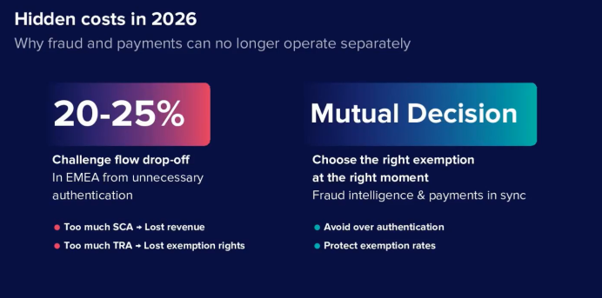
Shelly Assaf put a number on the cost of getting this wrong. EMEA merchants see a 20-25% drop-off in the challenge flow purely from unnecessary authentication. Too much SCA means lost revenue; too much TRA means lost exemption rights. The fix? A mutual decision between fraud intelligence and payments, made in sync.
Orchestration has outgrown routing
Many merchants still equate orchestration with routing – but Adam highlighted that routing is now the most basic capability in the category: every platform can do it. The real value has moved upstream into pre-authorisation strategy: which payment methods to display, whether to request an exemption before forwarding to the acquirer, and which acquirer suits a given BIN range. These decisions now have to happen dynamically, at millisecond speeds, which is exactly where AI is closing the loop.
3DS is not a binary decision
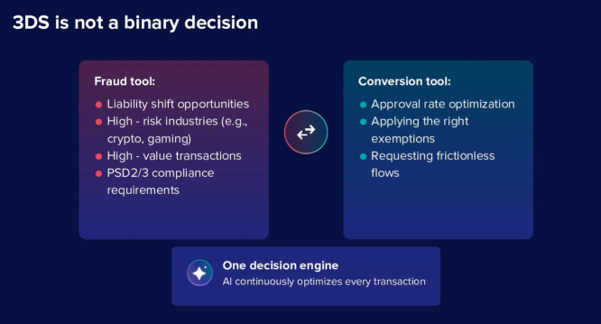
Shelly pushed back on treating 3DS as purely a compliance checkbox. As Adam framed it: as a fraud tool, 3DS offers liability shift for high-risk industries and high-value transactions. As a conversion tool, it's about approval rate optimisation and requesting frictionless flows. The two aren’t in competition – the shift is toward one AI-driven decision engine optimising both at once.
Adam also shared a striking attack pattern: traders exploiting the 3DS timeout window to perform price arbitrage on volatile digital assets, waiting to see whether their locked-in rate still favoured them before completing authentication.
Friction isn’t the enemy - complexity is
Shelly’s biggest misconception to flag is that 3DS doesn’t always mean friction, since frictionless flows still deliver liability shift invisibly. Her own example is a 3DS challenge on an unfamiliar high-value purchase that made her feel more protected.
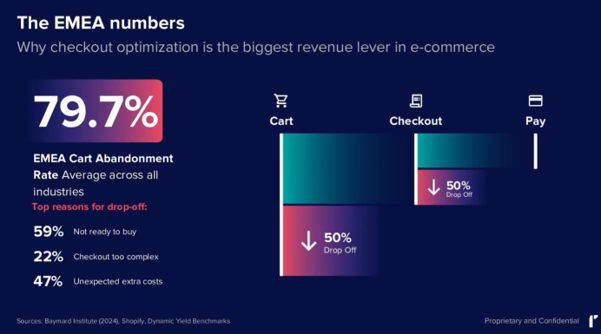
The real damage, Riskified’s benchmark data shows, happens elsewhere: EMEA’s average cart abandonment rate sits at 79.7%. Only 59% of that is simply shoppers not ready to buy. The rest is checkout complexity (22%) and unexpected extra costs (47%), both squarely within a merchant’s control.
Who decides when to invoke 3DS
Both speakers converged on the same answer: neither the payment stack nor the fraud platform has the full picture alone. Adam warned that silos lead to fraud trauma-driven over-challenging and missed exemptions, soft declines merchants pay for twice.
On AI, Shelly flagged biased or purchased third-party training data and the growing black box problem: customers call asking why a legitimate order was declined. Adam added that under the EU AI Act, explainability isn’t optional; his view is that AI still can’t replace hard, simple rules for clear-cut cases, but excels at catching anomalies humans never would.
Fraud isn’t going away
Both speakers agreed that fraud isn’t going away. As Adam put it, recalling early advice from a mentor, if you don’t have fraud, you don’t have a business. What changes is the sophistication of the defence – and both were clear that visibility comes before optimisation. As Shelly summarised, you cannot fix conversion or fraud rates without seeing the full picture first.
This recap only covers the surface – the regulatory divergence between the EU, US, and Japan, the full BNPL case study, and audience Q&A all go inside the recording. Watch the full webinar here.
About Paula Albu

Paula Albu has experience in content writing and editing, as well as being a creative storyteller. As a Junior Editor at The Paypers, she investigates Web3 technologies along with the latest trends and regulations in banking and fintech. Paula is committed to turning complex industry topics into engaging, accessible content that resonates with readers and creates a meaningful connection. She is available via LinkedIn or at paula@thepaypers.com.
About Riskified

Riskified empowers businesses to unleash ecommerce growth by outsmarting risk. Many of the world’s biggest brands and publicly traded companies selling online rely on Riskified for guaranteed protection against chargebacks, to fight fraud and policy abuse at scale, and to improve customer retention. Developed and managed by the largest team of ecommerce risk analysts, data scientists and researchers, Riskified’s AI-powered fraud and risk intelligence platform analyses the individual behind each interaction to provide real-time decisions and robust identity-based insights.