The real cost of waiting: what BPC's migration guide reveals

Vlad Macovei
18 Sep 2026 / 5 Min Read
For many banks, legacy technology still performs the basic task it was built for: processing transactions. That's exactly why modernisation is often delayed - if the system still runs, replacing it can seem optional. But the real issue isn't whether legacy platforms still work. It's whether they let the bank compete, adapt, and grow at the speed the market now demands.
According to BPC's Modernisation Without Disruption guide, legacy infrastructure is no longer only a technology problem: it's a business problem tied to resilience, cost, product agility, and customer preference. Modern banking depends on real-time processing, cloud scalability, API connectivity, and open banking readiness - requirements legacy systems, built for batch processing and siloed products, often struggle to support.
Here are the key takeaways.
The cost of legacy is hidden, and that's exactly the problem
It's easy to measure licensing, maintenance, and infrastructure expenses. It's much harder to quantify lost approvals, manual interventions, delayed launches, and weaker fraud performance - yet these are exactly where legacy systems quietly reduce profitability. BPC highlights four hidden cost areas: authorisation leakage, operational drag, opportunity cost, and fraud inefficiency. In practice, that means more legitimate transactions declined, more back-office work to fix issues, slower product launches, and a poorer balance between fraud prevention and customer experience.
False declines: a concrete, quantifiable loss
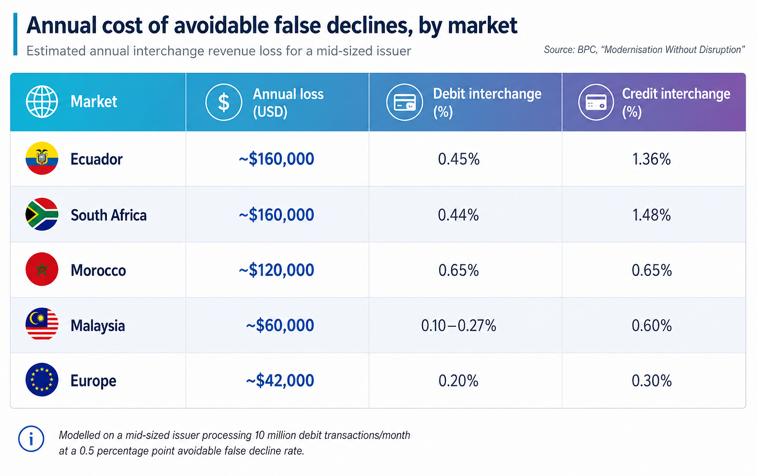
The guide's false decline example makes the point precisely. A portfolio with 10 million attempted debit transactions per month, and an avoidable false decline rate of just 0.50 percentage points, loses 50.000 legitimate transactions monthly. At an average transaction value of USD 30, that's USD 1.5 million in lost approved spend every month - before factoring in the wider effect on customer trust and card usage.
The annual interchange loss that results varies significantly by market:
Migration projects don't fail because banks chose to modernise
They fail because execution complexity is underestimated. The guide points to risk areas that are easy to overlook but highly consequential: wallet continuity, tokenised card status, BIN and scheme dependencies, reconciliation logic, and post-go-live monitoring. Migration risk lives in the operational detail, not the decision itself - which is why the guide frames migration as an enterprise change programme, not a technology swap. Disruption is reduced not by avoiding change, but by controlling it: validating data, running multiple mock migrations, and piloting before wider rollout.
There's no single correct migration path
The guide outlines four routes, each with different trade-offs. Big Bang offers the fastest cutover but the highest risk, best when the legacy platform is fragile and testing is already mature. A Conservative Pilot Run lowers risk by introducing the new platform to a smaller population first. Parallel Run keeps both systems active simultaneously for live comparison and stronger rollback options, at higher cost. For large, complex banks, Phased or Box Migration enables sequential rollout by BIN, product, or module while preserving continuity.
Planning discipline matters more than platform or scale
Two case studies in the guide illustrate what separates an optimal migration from a disruptive one. In one MEA deployment, a bank migrated 4 million cards and 600 ATMs while simultaneously expanding its issuing and acquiring capabilities. In an APAC example, a bank migrated 5 million customers, 30 BINs, and roughly 50 million data records, completing go-live during a high-volume salary-day window after five mock migrations. Neither project succeeded because of scale: both relied on rigorous mock migrations, clear rollback criteria, and close alignment between IT, operations, and compliance teams before go-live. That's the real differentiator was about planning discipline and execution precision, not the size of the institution or the ambition of the project.
Key takeaways
- Legacy infrastructure is now a growth, resilience, and cost problem, not just a technology one.
- The real cost is hidden: authorisation leakage, operational drag, opportunity cost, and fraud inefficiency quietly erode profitability.
- A 0.50 percentage point avoidable false decline rate on 10 million monthly transactions costs a mid-sized issuer USD 1.5 million a month.
- Migration projects fail on execution detail, not on the decision to modernise.
- No single migration path fits all: Big Bang, Pilot Run, Parallel Run, and Phased/Box Migration suit different risk profiles.
- The target platform's architecture matters as much as the migration path chosen.
The bottom line
The guide's strongest conclusion is that the real strategic question is no longer whether banks should modernise - it's how, in a way that balances speed, risk, cost, and continuity. Banks that stay too long on legacy systems may avoid short-term disruption but often absorb larger long-term losses through slower change and reduced competitiveness. The institutions most likely to succeed treat migration as a business transformation programme, choose the path that fits their operating reality, and execute with precision from planning through post-go-live control.
This article only highlights the key points of BPC's guide. For the full framework, case studies, and migration checklists, download the complete guide.
About Vlad Macovei

Vlad is a Senior Editor at The Paypers, working in the Banking & Fintech team. He uses his research, content, and people skills for all activities revolving around Open Banking and Open Finance. Vlad has a degree in Biology and Molecular Genetics and an extensive background in creative writing. You can reach out to him on LinkedIn.
About the company

BPC is a proven industry leader that is shaping the world of transactions with quick, safe and easy payment processing. With a focus on exceptional technology development and customer service, BPC helps financial institutions and businesses to deliver innovative and best-in-class proven solutions that fit with today’s consumer lifestyle when banking, shopping, or moving in both urban and rural areas. With more than 500 customers across 140 countries, BPC collaborates with all ecosystem players to deliver services for the digital world. Its core product SmartVista suite comprises cutting-edge banking, commerce, and mobility platforms that enable innovative solutions for digital banking, ATM and switching, payments processing, card, and fraud management, financial inclusion, merchant portals, transport, and smart cities. To find out more about how BPC can help businesses deliver a seamless payments processing experience to consumers, please visit www.bpcbt.com
News on Fintech
Expert views on Fintech

The Paypers is a global hub for market insights, real-time news, expert interviews, and in-depth analyses and resources across payments, fintech, and the digital economy. We deliver reports, webinars, and commentary on key topics, including regulation, real-time payments, cross-border payments and ecommerce, digital identity, payment innovation and infrastructure, Open Banking, Embedded Finance, crypto, fraud and financial crime prevention, and more – all developed in collaboration with industry experts and leaders.
Current themes


No part of this site can be reproduced without explicit permission of The Paypers (v2.7).
Privacy Policy / Cookie Statement
Copyright