Europe’s payment landscape is constantly changing, with rails converging fast through SEPA, open banking, and Wero. Consumer habits are not. What earns trust at checkout is still decided market by market, and getting it wrong costs merchants sales through abandoned baskets.
In the webinar hosted by The Paypers and Nuvei, How Europe pays: The real cost of one-size-fits-all payments, Advait Sinha, VP of Product Strategy at Nuvei, and Mantas Eitutis, Head of Payments and Risk at Eneba, joined moderator Masha Cilliers, Payment Industry Expert, iNED, and Board Advisor, to discuss Nuvei’s new research, How Europe pays, on how 5.000 consumers across five European markets choose to pay.
Here are the key takeaways from the webinar.
Five markets, five habits
Advait explained that two-thirds of consumers stay loyal to their existing payment method, and more than a quarter would abandon a purchase if it’s not available. Payment methods are therefore a retention tool, but their absence can also come at a cost to conversion.
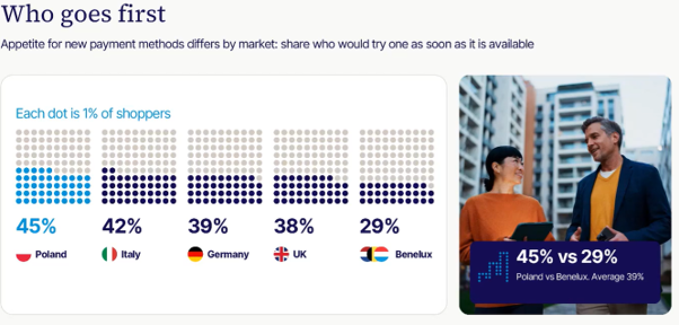
The differences between markets are striking. In Poland, 45% of consumers would try a new payment method as soon as it became available, followed by Italy (42%), Germany (39%), and the UK (38%), while Benelux lagged at 29%. According to the report, Poland is the most engaged and open market, while German shoppers are the most flexible about how they pay.
Source: Nuvei, How Europe Pays research, 5.000 consumers
Mantas recognised the diversity, although the most popular methods vary by market. At Eneba, a digital games marketplace working with 17 acquirers and more than 150 payment methods, PayPal leads in Germany, BLIK dominates in Poland, and in the Netherlands, iDEAL is so entrenched that shoppers may not buy without it.
Choosing payment methods
Advait suggested merchants start with what is popular in each market, then weigh four factors: demand, incrementality (whether a method reaches customers they would not otherwise win), cost and risk (from chargebacks to reconciliation), and trajectory (whether a method is growing or being phased out). Before removing a method, he advised testing its removal on a smaller segment first.
The product matters too: a subscription business in Poland now needs BLIK, which has introduced recurring payments and has seen its volumes grow since.
Payment methods build trust
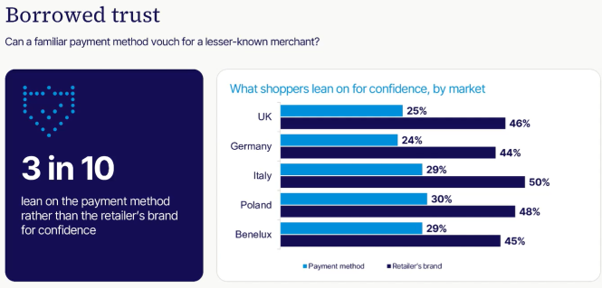
For first-time buyers who do not know the marketplace, a familiar payment method signals that the brand is safe. Eneba even keeps PayPal visible as a trust badge when it is temporarily unavailable. Once a purchase goes smoothly, that trust shifts to the brand itself: 70% of Eneba’s users are returning customers. Advait added that three in ten consumers rely on the payment method rather than the retailer’s brand for confidence.
Source: Nuvei, How Europe Pays research, 5.000 consumers
That is why payment strategy should go hand in hand with go-to-market planning. When a key method is missing, Eneba runs fake door tests: it shows the logo, measures how many users click on it, and rewards them with a discount for their next purchase. With Bizum in Spain, Mantas said the real question wasn't volume, but whether it brought in new customers or simply diverted traffic from existing methods.
AI: discovery first, purchases later
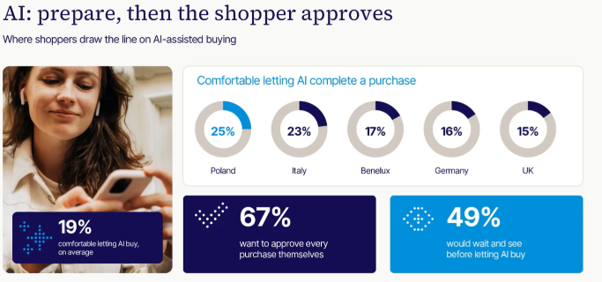
Nuvei’s research found that 19% of consumers are comfortable letting AI complete a purchase, while 67% want to approve every purchase themselves. Mantas sees very little agent-completed traffic at Eneba so far, but AI-assisted discovery, in which shoppers compare products and prices before arriving on the site, is growing fast.
Source: Nuvei, How Europe Pays research, 5.000 consumers
For Advait, the core challenge for agentic commerce is proving that a consumer intended to buy that item at that price. Cards have an early lead through Visa and Mastercard’s programmes and tokenization, but alternative payment methods still have time to define their own approach. Mantas also sees AI helping merchants show each shopper the most relevant payment methods first, but a simple search bar should remain in case the model gets it wrong.
What comes next?
Asked for one priority for the next three months, Advait recommended checking whether a local payment method in a core market could bring in genuinely new customers. Mantas suggested reviewing risk management and routing, with fraud checks moved before authorization to reduce costs and ensure cleaner traffic reaches issuers.
In Europe, the speakers agreed that there is no single right checkout, only the one that fits the needs of each market, product, and customer.
This overview highlights the key points of the discussion. For the full conversation, including the Q&A session at the end, watch the webinar recording here.
About Nuvei

Nuvei is the global fintech building the infrastructure for every payment, everywhere. Its flexible platform supports the full transaction lifecycle, giving the world's leading companies a single partner for local and cross-border commerce at scale, including the emerging wave of AI-driven agentic commerce. With reach in more than 190 markets, local acquiring in 50+ countries, 150 currencies, and over 720 alternative payment methods, Nuvei brings global infrastructure and local expertise to every market its customers serve.
For more information, visit www.nuvei.com