Physical cards are here to stay. Is your issuance model keeping up?
Paula Albu
09 Nov 2026 / 5 Min Read
Ten years ago, many predicted the end of the plastic card. Instead, it is having a revival. Fintechs without branches use the card as their most tangible link with customers, and issuers are investing in new designs, materials, and packaging. However, the way a card actually reaches the customer has barely changed in 20 years.
In the webinar hosted by The Paypers and Thales, ‘Physical cards are here to stay. It’s time to rethink issuance’, Cyril Gabon, Vice President and Business Owner for Card Issuance at Thales Payment Services, Anthony Poujol, Head of Cards at Nickel, and Kelly Hernandez, Senior Partnership Operations Manager at Lithic, joined moderator Esther Groen to discuss why the physical card still matters, what happens inside the issuance ‘black box’, and what it takes to open it up.
Here are the key takeaways from the webinar.
The card – an experience, not just a product
Cyril explained that premium and metal cards have been growing by more than 10% a year for the past five to six years, keeping pace with digital payments.
Anthony said the card endures for two reasons. The first is resilience: payment is an essential service, Europe is discussing offline payments linked to the physical card, and many customers still don't fully trust their phone to pay. The second is the object itself. Nickel’s limited editions, including a mirror card and a card that lights up when used, demonstrate a strong appetite for beautiful cards.
Kelly added that fintechs of every size now expect a premium card and experience at an affordable price, with expectations spanning the material and unboxing to customisation, speed to market, and visibility at every step.
That makes the experience after the card is ordered just as important as the card itself. A premium design can create excitement, but slow or opaque fulfilment can quickly undermine it. The panel argued that speed and visibility throughout issuance increasingly influence customer trust and how quickly the card enters use.
Inside the black box
Cyril explained that the journey from order to doormat has hardly evolved in two decades. Files pass from the issuer to processor, then to the personalisation bureau and on to the postal service, typically taking more than five days, with little visibility into what happens along the way. When something goes wrong, teams wait for next-day reconciliation reports, and batch files cannot be traced card by card.
The costs are real, but often fragmented. Based on Thales' experience with issuers, around 25% of inbound calls can relate to “where is my card?” enquiries, while 7–9% of cards may be returned as undelivered. Nickel broadly recognised the pattern. Each exception can trigger investigation, customer-service activity and potentially reissuance.
Because the cost is spread across the call centre, operations, marketing, and reissuance, nobody sees the full bill.
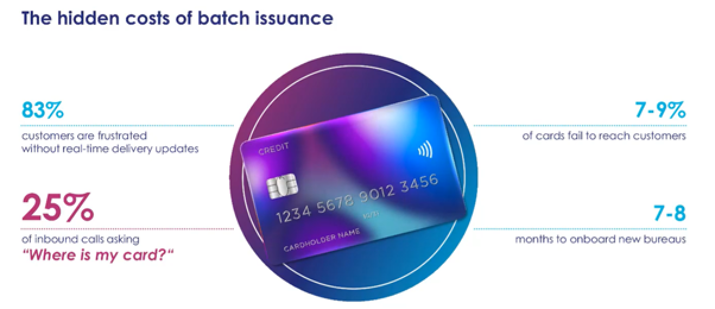
Source: Thales. 83% figure from Retail Rewired, 2025; other figures from a Thales study.
A key question is how much cardholders should see. Anthony prefers to show only key statuses, such as ordered and dispatched, since too much detail can prompt more calls, while keeping full monitoring internally. Cyril agreed: issuers should get full transparency and decide how much to share.
From visibility to control
Modernisation is not simply about replacing a batch file with an API. The bigger change is moving from visibility to control.
Kelly explained that in a real-time model, where information flow both ways, issuers can act on an individual order, for example by rushing or cancelling it, updating an address, or identifying a problem closer to its source. Instead of discovering exceptions through the next reconciliation file, operations teams can increasingly monitor and act on them as they happen.
Making physical issuance move at digital speed
Speed to market is another reason to rethink issuance. In a traditional file-based environment, changes can become IT projects lasting weeks, while launching a new programme or personalisation setup can take six to seven months.
That pace increasingly clashes with market expectations. Kelly said Lithic's fintech customers expect to launch in weeks, not months, and want to add features or expand into new markets without rebuilding their operations each time.
With a more standardised, API-based model, Cyril said new-project timelines can fall to around three to four months, while existing issuers can add new geographies or personalisation centres in weeks. As digital experiences get faster, physical issuance needs to keep up.
What holds issuers back
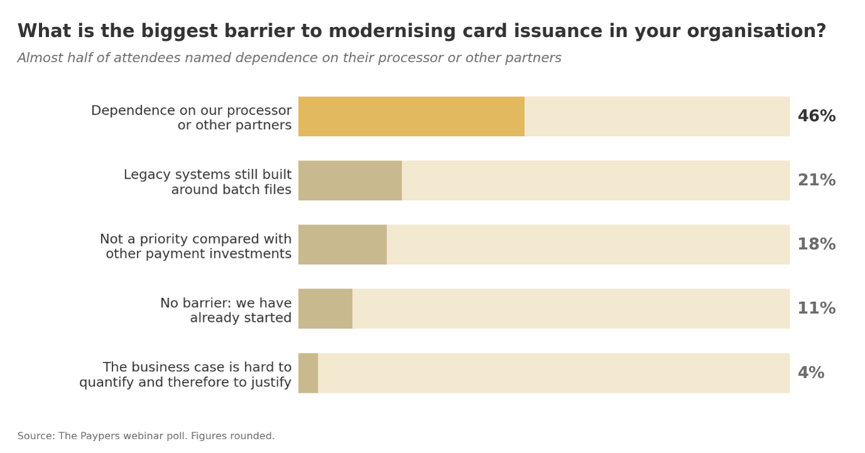
A live poll asked attendees about the biggest barrier to modernising card issuance. Almost half (46%) named dependence on their processor or other partners, followed by legacy batch systems (21%).
The speakers also shared their perspectives on how issuers can overcome these barriers. Kelly’s advice was to involve the processor as early as possible, since it can be either the blocker or the accelerator. Cyril highlighted that modernisation does not need a big bang: issuers can move one product family at a time.
The business case will also look different for different issuers. Anthony said Nickel did not justify the move through a simple direct-revenue calculation; it was a strategic investment in an architecture capable of supporting tomorrow's services. For more established issuers, however, Cyril argued that the case may also come from productivity gains, particularly where batch processing still creates significant reconciliation and manual work.
What comes next?
The physical card is not disappearing, but the infrastructure behind it is changing. Digital payments have reset customer expectations for speed, visibility and control, and physical issuance increasingly has to meet the same standard.
For issuers, that does not have to mean replacing everything at once. The panel's message was pragmatic: identify where today's black box creates cost or friction, involve the processor early, and modernise product by product where necessary.
This webinar recap highlights the key points of the discussion. For the full conversation, including the Q&A session at the end, watch the webinar recording here.
About the author

Paula Albu has experience in content writing and editing, as well as being a creative storyteller. As a Junior Editor at The Paypers, she investigates Web3 technologies along with the latest trends and regulations in banking and fintech. Paula is committed to turning complex industry topics into engaging, accessible content that resonates with readers and creates a meaningful connection. She is available via LinkedIn or at paula@thepaypers.com.
About Thales

Thales (Euronext Paris: HO) is a global leader in advanced technologies for the Defence, Aerospace, and Cyber & Digital sectors. Its portfolio of products and services helps address several major challenges: sovereignty, security, sustainability and inclusion. The Group allocates EUR 4.5 billion per year to Research & Development in key areas, particularly for critical environments, such as Artificial Intelligence, Cybersecurity, Quantum and Cloud technologies. Thales has more than 85.000 employees in 65 countries. In 2025, the Group generated sales of EUR 22.1 billion. For more information about Thales’ payment services, please visit our website: https://www.thalesgroup.com/en/enterprise/financial-services.
News on Payments
Expert views on Payments

The Paypers is a global hub for market insights, real-time news, expert interviews, and in-depth analyses and resources across payments, fintech, and the digital economy. We deliver reports, webinars, and commentary on key topics, including regulation, real-time payments, cross-border payments and ecommerce, digital identity, payment innovation and infrastructure, Open Banking, Embedded Finance, crypto, fraud and financial crime prevention, and more – all developed in collaboration with industry experts and leaders.
Current themes


No part of this site can be reproduced without explicit permission of The Paypers (v2.7).
Privacy Policy / Cookie Statement
Copyright